The best interactive dog puzzle toy for most households is the Outward Hound Nina Ottosson Dog Tornado, which pairs a manageable Level 2 challenge with treat-hiding compartments. For dogs ready for more involved problem-solving, the Level 4 Tower of Treats offers a tougher alternative, while the Wobble Treat-Dispensing Puzzle Toy suits small dogs and puppies who benefit from movement-based play. The main tradeoff is between easy-to-learn, stationary puzzles and harder toys that take more setup or supervision. Size, chewing habits, cleaning needs, and whether your dog prefers sliding, lifting, or nudging all affect the fit. Read on for the full breakdown and guidance on choosing a toy your dog can use safely.
Complete the kit


Key Takeaways
- The Dog Tornado is the clearest all-around starting point: its Level 2 format offers more structured problem-solving than a simple treat dispenser without the steeper learning curve of the Level 4 Tower.
- Challenge level matters more than the number of moving parts: the Tower of Treats is aimed at practiced puzzle solvers, while the Tornado and Dog Brick are more approachable for dogs learning basic search actions.
- Not every puzzle asks dogs to think in the same way: sliders and liftable pieces favor paw-and-nose exploration, while wobble dispensers reward nudging and movement.
- Several listings split by color or broad feature set rather than a clearly distinct play style: DR CATCH’s blue and pink versions should be chosen by fit and preference, not treated as different puzzle formats.
- Food cleanup and dog behavior can decide the practical winner: slow-feeder designs may suit fast eaters, but dogs that chew puzzle parts or lose interest without quick rewards need a different match and supervision.
| FOXMM Interactive Dog Treat Puzzle Toy with Squeaker, Slow Feeder |  | Best for Squeaker-Responsive Small Pets | Dimensions: 10 x 10 x 1.2 in | Weight: 0.4 kg | Material: Food-grade polypropylene | VIEW LATEST PRICE | See Our Full Breakdown |
| Outward Hound Nina Ottosson Dog Tornado Treat Puzzle, Level 2 |  | Best for a Clear Intermediate Challenge | Difficulty: Level 2 (Intermediate) | Treat compartments: 12 | Spinning layers: 3 | VIEW LATEST PRICE | See Our Full Breakdown |
| Outward Hound Nina Ottosson Tower of Treats Dog Puzzle, Level 4 |  | Best for Expert Puzzle Solvers | Difficulty: Level 4 Expert | Hidden treat compartments: 28 | Dimensions: 12.5 x 12.5 x 4.2 in | VIEW LATEST PRICE | See Our Full Breakdown |
| Outward Hound Nina Ottosson Dog Brick Treat Puzzle, Level 2 |  | Best for Variety in an Intermediate Puzzle | Difficulty: Level 2 (Intermediate) | Treat compartments: 20 | Dimensions: 12.75 x 8.75 x 1.75 in | VIEW LATEST PRICE | See Our Full Breakdown |
| Interactive Dog Puzzle Treat Dispenser for Training and Mental Stimulation |  | Best Compact Built-In Slider | Brand: Yoboeew | Material: Polypropylene | Dimensions: 10 x 10 x 1.1 in | VIEW LATEST PRICE | See Our Full Breakdown |
| BoYoYo Interactive Dog Treat Puzzle Toy, Yellow |  | Best Rolling Dispenser | Brand: BoYoYo | Toy type: Rolling treat dispenser puzzle | Material: ABS, nylon, polyester, and rubber | VIEW LATEST PRICE | See Our Full Breakdown |
| PETSTA Dog Puzzle Toy and Treat Dispenser |  | Best for Multi-Action Enrichment | Brand: PETSTA | Material: Polypropylene | Treat compartments: 16 | VIEW LATEST PRICE | See Our Full Breakdown |
| DR CATCH Dog Puzzle Feeder Toy, Blue |  | Best for Small-Dog Beginners | Material: Polyvinyl chloride (PVC) | Dimensions: 9.44 × 9.44 × 1.14 inches | Weight: 12.64 ounces | VIEW LATEST PRICE | See Our Full Breakdown |
| DR CATCH Dog Puzzle Feeder Toy, Pink |  | Best Portable Scent-Training Feeder | Toy type: Puzzle feeder | Size: 9.44 × 9.44 × 1.14 inches | Item dimensions: 9.6 × 9.6 × 1.4 inches | VIEW LATEST PRICE | See Our Full Breakdown |
| KADTC Dog Chess Puzzle Toy, 3-Level Treat Dispenser and Slow Feeder |  | Best for Advanced Puzzle Sessions | Brand: KADTC | Material: Food-grade ABS | Difficulty levels: 3 | VIEW LATEST PRICE | See Our Full Breakdown |
| Barkwhiz Dog Puzzle Toy, 3 Levels |  | Best for Varied Treat Challenges | Toy type: Puzzle | Material: Plastic | Difficulty levels: 3 | VIEW LATEST PRICE | See Our Full Breakdown |
| Wobble Treat-Dispensing Puzzle Toy for Small Dogs, Cats, and Puppies |  | Best for Small-Pet Starter Play | Toy type: Treat dispenser and puzzle toy | Recommended pets: Small dogs, cats, and puppies | Dimensions: 3.46 × 3.46 × 5.12 inches | VIEW LATEST PRICE | See Our Full Breakdown |
| Potaroma Two-Level Dog Puzzle Toy and Slow Feeder |  | Best for Slow Feeding from a Reservoir | Brand: Potaroma | Target species: Dog | Material: Polypropylene and rubber | VIEW LATEST PRICE | See Our Full Breakdown |
| interactive dog puzzle toy | Dimensions | Material | Weight |
|---|---|---|---|
| FOXMM Interactive Dog Treat Pu | 10 x 10 x 1.2 in | Food-grade polypropylene | 0.4 kg |
| Outward Hound Nina Ottosson Do | 9.75 x 7.25 x 3.07 in | Plastic | 1.2 lb |
| Outward Hound Nina Ottosson To | 12.5 x 12.5 x 4.2 in | Plastic | 2.8 lb |
| Outward Hound Nina Ottosson Do | 12.75 x 8.75 x 1.75 in | Plastic | 250 g |
| Interactive Dog Puzzle Treat D | 10 x 10 x 1.1 in | Polypropylene | — |
| BoYoYo Interactive Dog Treat P | 6.7 × 3.82 × 3.82 inches | ABS, nylon, polyester, and rubber | 10.6 ounces |
| PETSTA Dog Puzzle Toy and Trea | Description: 10 × 10 × 1.3 inches; listed item dimensions: 8 × 8 × 1 inch | Polypropylene | — |
| DR CATCH Dog Puzzle Feeder Toy | 9.44 × 9.44 × 1.14 inches | Polyvinyl chloride (PVC) | 12.64 ounces |
| DR CATCH Dog Puzzle Feeder Toy | — | — | — |
| KADTC Dog Chess Puzzle Toy | 16.73 × 16.73 × 2.64 inches | Food-grade ABS | 2.3 pounds |
| Barkwhiz Dog Puzzle Toy | 11.5 × 9.3 × 2 inches | Plastic | 1.3 pounds |
| Wobble Treat-Dispensing Puzzle | 3.46 × 3.46 × 5.12 inches | ABS | 10.72 ounces |
| Potaroma Two-Level Dog Puzzle | 10.2 × 10.2 × 4.2 inches | Polypropylene and rubber | 1.3 pounds |
More Details on Our Top Picks
FOXMM Interactive Dog Treat Puzzle Toy with Squeaker, Slow Feeder
The FOXMM pairs a sliding treat puzzle with a built-in squeaker, giving sound-responsive pets another cue to investigate. Its shallow, 10-inch UFO shape suits small and medium dogs and cats, while the treat compartments can turn part of a meal into a slower, more interactive activity. Compared with the Outward Hound Dog Tornado, which uses three spinning layers, this has a simpler sliding format and a squeaker rather than a layered challenge. That makes it a more approachable pick for pets drawn to sound, though it may offer less variety for dogs that already solve treat puzzles quickly. The polypropylene body is washable, including in a dishwasher, but this is not a chew toy; supervision and replacement if damaged are part of using it safely.
Pros:- Built-in squeaker can attract pets who need an extra prompt to engage.
- Sliding pieces provide treat-based mental activity and can slow eating.
- Washable polypropylene construction is suitable for water or dishwasher cleaning.
Cons:- Not intended for chewing and needs supervision during play.
- The sliding format may feel limited to experienced puzzle solvers.
- Small and medium sizing may not suit larger dogs.
Best for: People with small or medium dogs or cats who respond to squeaks and want a washable sliding puzzle for indoor treat time.
Not ideal for: Owners of persistent chewers or dogs that need a more involved, multi-stage challenge than sliding pieces.
- Dimensions:10 x 10 x 1.2 in
- Weight:0.4 kg
- Material:Food-grade polypropylene
- Toy type:Sliding treat puzzle and slow feeder
- Shape and color:UFO; blue
- Suitable pets:Dogs and cats; recommended for small and medium breeds
- Cleaning:Washable with water or in the dishwasher
- Other feature:Built-in squeaker
Our verdict“Choose the FOXMM for a squeaker-assisted, washable sliding puzzle for small pets, but skip it for chewers or dogs ready for layered challenges.”
Outward Hound Nina Ottosson Dog Tornado Treat Puzzle, Level 2
The Dog Tornado is a strong fit for dogs ready to move beyond a single sliding action: its three spinning layers conceal treats across 12 compartments, asking a dog to nose or paw through several linked search points. It holds up to 1/2 cup of food, so it can serve as a modest slow feeder as well as a short enrichment session. Compared with the FOXMM’s flatter slider-and-squeaker layout, the Tornado gives dogs more compartments and a more layered task, but it lacks an attention-getting squeaker. It is also less involved than the Tower of Treats, which is designed for expert-level sequential actions. The lightweight plastic is easy to clean and made without BPA, PVC, lead, or phthalates; the tradeoff is that it is not water resistant and needs treats or kibble to make the puzzle work.
Pros:- Three spinning layers and 12 compartments create a more involved search than a basic slider.
- Holds up to 1/2 cup of kibble or treats and can function as a slow feeder.
- Lightweight and easy to clean.
- Made without BPA, PVC, lead, or phthalates.
Cons:- Not water resistant.
- Requires kibble or treats for the puzzle activity.
- Its intermediate challenge may not hold the interest of experienced puzzle solvers.
Best for: Owners of dogs that have mastered simple treat searches and want an intermediate, compartment-based puzzle that can also hold part of a meal.
Not ideal for: People seeking a water-resistant toy, a no-food activity, or an expert-level puzzle for a dog that already solves Level 2 games quickly.
- Difficulty:Level 2 (Intermediate)
- Treat compartments:12
- Spinning layers:3
- Capacity:Up to 1/2 cup of kibble or treats
- Dimensions:9.75 x 7.25 x 3.07 in
- Weight:1.2 lb
- Material:Plastic
- Safety materials:Made without BPA, PVC, lead, or phthalates
Our verdict“Pick the Tornado for a practical step up to layered treat searching, rather than the simpler FOXMM or expert-focused Tower of Treats.”
Outward Hound Nina Ottosson Tower of Treats Dog Puzzle, Level 4
The Tower of Treats is the most demanding option in this group, with 28 hidden compartments and a sequence involving levers, a wheel, sliding doors, and drawers. That variety gives dogs that have already mastered easier games more to work through than the Tornado’s spinning layers or the Brick’s lids and sliders. Its difficulty can be adjusted, which offers some room to tailor the challenge, but the stated Level 4 expert rating makes this a poor starting point for a beginner: a dog that cannot work out the actions may lose interest rather than gain enrichment. At 12.5 inches square and 2.8 pounds, it also takes more floor space than the compact FOXMM. The design has no removable parts and is made without BPA, PVC, lead, or phthalates, though it is not water resistant.
Pros:- 28 compartments and several distinct actions create an extended, varied challenge.
- Adjustable difficulty can help tailor play as a dog learns.
- No removable parts are listed, reducing the number of loose components to manage.
- Made without BPA, PVC, lead, or phthalates.
Cons:- Level 4 complexity is unsuitable for dogs that have not mastered easier puzzles.
- Its 12.5-inch-square footprint needs more floor space than smaller options.
- Not water resistant.
Best for: Owners of dogs that have mastered Level 3 puzzles and enjoy working through several different treat-retrieval actions.
Not ideal for: First-time puzzle buyers, dogs that become frustrated by complex tasks, or households needing a water-resistant or compact toy.
- Difficulty:Level 4 Expert
- Hidden treat compartments:28
- Dimensions:12.5 x 12.5 x 4.2 in
- Weight:2.8 lb
- Material:Plastic
- Parts:No removable parts
- Safety materials:Made without BPA, PVC, lead, or phthalates
- Use:Indoor mental stimulation, play, and training
Our verdict“Choose the Tower of Treats for an experienced puzzle solver that needs more varied actions than the Tornado or Brick provides.”
Outward Hound Nina Ottosson Dog Brick Treat Puzzle, Level 2
The Dog Brick suits owners who want more than one type of treat-hiding action without stepping up to the Tower of Treats’ expert-level sequence. Dogs can work with lids, sliders, and bone covers across 20 compartments, and the adjustable setup lets an owner match the game to a dog’s current skill. Compared with the Tornado, which concentrates on spinning layers, the Brick spreads the task across different mechanisms; that variety can help keep a familiar treat-search routine from feeling repetitive. It can also serve as a slow feeder, though the listed capacity is inconsistent: the description says 3/4 cup, while product details say 1-1/2 cups. I would not choose it when exact meal capacity matters. Its lightweight plastic is easy to clean, but it is not water resistant.
Pros:- Combines lids, sliders, and bone covers for more action variety than the Tornado’s spinning layers.
- Adjustable difficulty can suit a range of problem-solving abilities.
- Can be used as a slow feeder for kibble or treats.
- Lightweight and easy to clean; made without BPA, PVC, lead, or phthalates.
Cons:- Listed capacity conflicts between 3/4 cup and 1-1/2 cups.
- Not water resistant.
- The broad, shallow board needs a flat surface for play.
Best for: Owners of dogs at different puzzle skill levels who want an adjustable Level 2 board with several ways to uncover treats.
Not ideal for: Buyers who need a dependable stated food capacity or a water-resistant puzzle for use outside or around water.
- Difficulty:Level 2 (Intermediate)
- Treat compartments:20
- Dimensions:12.75 x 8.75 x 1.75 in
- Weight:250 g
- Material:Plastic
- Listed capacity:3/4 cup in description; 1-1/2 cups in product details
- Recommended pet:Dogs of all life stages
- Safety materials:Made without BPA, PVC, lead, or phthalates
Our verdict“Pick the Dog Brick for varied, adjustable Level 2 play, but choose another option if reliable meal-capacity information is a priority.”
Interactive Dog Puzzle Treat Dispenser for Training and Mental Stimulation
This round Yoboeew puzzle keeps its moving pieces built into a 10-inch polypropylene board, so there are no listed loose pieces to reset or gather after play. Sliding parts reveal hidden food, and the design can also make a small meal more interactive as a slow feeder. Compared with the FOXMM, it shares a compact slider format and dishwasher-safe construction, but the FOXMM adds a squeaker; the Yoboeew instead emphasizes built-in pieces that are designed not to come out easily. Its small-pet sizing is a clear limit, and the required sliding actions may be hard for beginners who have not learned how treat puzzles work. It is a more suitable fit for small dogs, puppies, cats, and other small animals than for larger dogs or pets that need an introductory, low-effort game.
Pros:- Built-in play pieces are designed not to come out easily.
- Sliding actions offer food-based mental activity and can support slower feeding.
- Polypropylene construction is dishwasher safe and washable with water.
Cons:- Designed primarily for small pets, so it may not fit larger dogs.
- Sliding and moving the center pieces may challenge puzzle beginners.
- Unlike the FOXMM, it has no listed squeaker to draw a pet’s attention.
Best for: People with small dogs, puppies, or cats who want an indoor sliding puzzle with built-in pieces and easy dishwasher cleanup.
Not ideal for: Owners of large dogs or beginners who need a simpler first puzzle and may struggle with moving multiple sliders.
- Brand:Yoboeew
- Material:Polypropylene
- Dimensions:10 x 10 x 1.1 in
- Listed weight:335 g (also listed as 0.9 lb)
- Pet types:Dogs and cats
- Recommended size:Small and medium breeds
- Cleaning:Dishwasher safe; washable with water
- Removable parts:No; built-in play pieces
Our verdict“Choose the Yoboeew for a compact, built-in slider for small pets, and favor the Tornado or Brick for a more varied intermediate challenge.”
BoYoYo Interactive Dog Treat Puzzle Toy, Yellow
The BoYoYo takes a different approach from the tabletop boards in this roundup: dogs roll it to release treats, turning food seeking into a moving activity. Two adjustable switches let you change how freely treats fall, which can extend feeding time or make play more challenging. Its rubber roller is designed to reduce noise, a useful detail for indoor play, and the toy comes apart for cleaning. Compared with the PETSTA’s fixed 16-compartment board, this offers more movement but less variety in puzzle actions. The tradeoff is supervision: it is intended for medium and large pets, not aggressive chewers, and its rolling format may be less suitable for dogs that prefer stationary puzzles. I’d choose it for a dog that enjoys pushing toys around rather than working sliders and lids.
Pros:- Two adjustable openings let owners change treat flow and challenge
- Rolling movement adds physical activity to treat seeking
- Can be disassembled for access to the food compartment
- Rubber roller material is designed to reduce indoor noise
Cons:- Not intended for aggressive chewers
- Requires supervision during play
- Rolling action offers less variety than puzzles with multiple distinct mechanisms
Best for: Owners of medium or large dogs who enjoy rolling toys and need an adjustable treat flow for supervised indoor enrichment
Not ideal for: Aggressive chewers or owners seeking a stationary, multi-action puzzle that can be left with a dog unattended
- Brand:BoYoYo
- Toy type:Rolling treat dispenser puzzle
- Material:ABS, nylon, polyester, and rubber
- Dimensions:6.7 × 3.82 × 3.82 inches
- Weight:10.6 ounces
- Food adjustment:Two adjustable switches
- Recommended pet size:Medium and large
- Cleaning:Dishwasher safe or hand wash
Our verdict“Choose the BoYoYo for a supervised, rolling treat challenge with adjustable dispensing rather than a stationary board puzzle.”
PETSTA Dog Puzzle Toy and Treat Dispenser
PETSTA earns its place through three different play designs in one board: a squeak button, spin-and-slide sections, and seek-and-hide compartments. That gives a dog more ways to work for food than the BoYoYo’s rolling dispenser, while its 16 treat compartments can spread out a meal for slower feeding. Built-in parts reduce the chance of loose pieces going missing, and the polypropylene board is dishwasher safe. The drawback is that this is still a low-profile, stationary puzzle, so it won’t appeal as much to dogs motivated by chasing a moving dispenser. The listed dimensions also conflict with the larger size stated in the description, making it harder to judge counter or floor space before buying. I’d favor it for supervised enrichment when variety matters more than portability.
Pros:- Three play designs offer more action variety than a single-mechanism puzzle
- Sixteen compartments can help slow treat or food consumption
- Built-in parts are designed to stay in place
- Non-slip pads and dishwasher-safe polypropylene support practical indoor use
Cons:- Not recommended for unsupervised use by aggressive chewers
- Conflicting listed and described dimensions make its footprint uncertain
- Stationary board play provides less movement than a rolling dispenser
Best for: Owners of large dogs who want several paw- and nose-based puzzle actions and a dishwasher-safe board for supervised meals
Not ideal for: Buyers who need reliable size information, a portable rolling toy, or a puzzle for unsupervised use with an aggressive chewer
- Brand:PETSTA
- Material:Polypropylene
- Treat compartments:16
- Play features:Squeak button, spin-and-slide, seek-and-hide
- Dimensions:Description: 10 × 10 × 1.3 inches; listed item dimensions: 8 × 8 × 1 inch
- Parts:Built-in, non-removable
- Cleaning:Dishwasher safe
- Use:Indoor training and enrichment
Our verdict“Pick PETSTA if you want several built-in puzzle actions and slow-feeding compartments in one washable board.”
DR CATCH Dog Puzzle Feeder Toy, Blue
The blue DR CATCH is a straightforward way to introduce a small dog to interactive feeding: food is hidden under sliding compartments, inviting nose and paw work without the rolling motion of the BoYoYo. Its broad, shallow board can serve both as a short puzzle session and as a way to make eating less hurried. At 9.44 inches square and 12.64 ounces, it is portable enough to move between indoor play areas, though it is not water resistant and is not described as indestructible. Compared with the larger KADTC board, this offers a simpler, smaller-scale challenge rather than multiple levels and 17 hiding spots. That simplicity suits puppies and small dogs, but limits its appeal for larger pets or dogs that quickly master basic sliders. Supervision and replacement if damaged are part of ownership.
Pros:- Sliding parts encourage dogs to use their nose or paws to find food
- Can help slow feeding while providing a simple enrichment task
- Lightweight design is easy to move around indoors
- Suitable in scale for cats, puppies, and small dogs
Cons:- Designed for small pets rather than larger dogs
- Not water resistant
- Requires supervision and replacement if damaged
Best for: Owners introducing a puppy or small dog to sliding food puzzles and looking for a lightweight indoor feeder
Not ideal for: Owners of medium or large dogs, aggressive chewers, or anyone seeking a water-resistant toy or advanced puzzle mechanisms
- Material:Polyvinyl chloride (PVC)
- Dimensions:9.44 × 9.44 × 1.14 inches
- Weight:12.64 ounces
- Color:Blue
- Pet size:Small
- Intended use:Puzzle feeding, mental stimulation, and training
- Use:Indoor
- Water resistance:Not water resistant
Our verdict“Choose the blue DR CATCH as a compact starter puzzle for a small dog that is ready to work sliding compartments.”
DR CATCH Dog Puzzle Feeder Toy, Pink
The pink DR CATCH shares the blue version’s sliding-compartment format, but its clearest appeal is as a lightweight feeder for small pets that need practice using scent and paws to uncover food. It can encourage slower eating while adding a simple foraging task, making it a more focused choice than the PETSTA board, whose three play designs provide broader action variety. The pink model’s listed size is around 9.5 inches square, with another item-dimension listing of 9.6 × 9.6 × 1.4 inches; either way, it is aimed at cats, puppies, and small breeds rather than larger dogs. It is not water resistant, and the guidance to supervise and replace it if damaged means it is not a leave-alone chew toy. I’d choose it for simple indoor scent work, not for a dog needing a more demanding puzzle.
Pros:- Sliding compartments give pets food to uncover through interactive play
- Can encourage slower feeding and natural foraging behavior
- Supports simple scent-training sessions
- Lightweight and sized for small pets
Cons:- Not water resistant
- Requires supervision and should be replaced if damaged
- Small-pet sizing and a single puzzle style may limit its use as a dog advances
Best for: Owners of cats, puppies, or small-breed dogs who want a portable sliding puzzle for indoor foraging and slower meals
Not ideal for: Owners of large dogs, aggressive chewers, or dogs that need multiple difficulty levels and varied puzzle mechanisms
- Toy type:Puzzle feeder
- Size:9.44 × 9.44 × 1.14 inches
- Item dimensions:9.6 × 9.6 × 1.4 inches
- Color:Pink
- Pet type:Cats and dogs
- Recommended breed size:Small breeds
- Additional features:Lightweight and portable
- Water resistance:Not water resistant
Our verdict“Pick the pink DR CATCH for portable, basic scent-and-slide enrichment with a cat, puppy, or small dog.”
KADTC Dog Chess Puzzle Toy, 3-Level Treat Dispenser and Slow Feeder
KADTC is the most involved board in this group, pairing three difficulty levels with 17 hiding spots made up of sliding discs, doors, and flip-lid cups. That range gives owners more room to adjust a session as a dog learns, unlike the simpler DR CATCH sliders, which are better suited to early puzzle practice. The board can also hold kibble for slow feeding, and four non-slip pads help keep a substantial 16.73-inch-square surface steady during play. Dishwasher-safe construction and drain holes make cleanup less fiddly, though the removable puzzle pieces need to be set up again between rounds. Its size and 2.3-pound weight are useful for a stable play area but less convenient for storage or travel. This is my pick for owners who want progression and can spare the floor or counter space.
Pros:- Three difficulty levels let owners adjust the challenge as a dog learns
- Seventeen hiding spots combine sliding, door, and flip-lid actions
- Can be used for kibble slow feeding as well as treats
- Non-slip pads and dishwasher-safe construction with drain holes aid play and cleanup
Cons:- The 16.73-inch-square board takes considerable storage and play space
- Puzzle components need setup between sessions
- At 2.3 pounds, it is less convenient to carry than compact feeders
Best for: Owners of small, medium, or large dogs who want adjustable puzzle difficulty and a board that can also slow kibble meals
Not ideal for: Buyers with limited storage space or anyone who wants a portable, ready-to-play toy with minimal setup
- Brand:KADTC
- Material:Food-grade ABS
- Difficulty levels:3
- Treat-hiding spots:17
- Components:9 treat discs, 4 sliding doors, and 4 flip-lid cups
- Dimensions:16.73 × 16.73 × 2.64 inches
- Weight:2.3 pounds
- Cleaning:Dishwasher safe; includes drain holes
- Recommended breed sizes:Small, medium, and large
Our verdict“Choose KADTC if you want a large, adjustable puzzle board that can grow with a dog’s problem-solving skills.”
Barkwhiz Dog Puzzle Toy, 3 Levels
Four treat games across three difficulty levels make the Barkwhiz a flexible pick for households that want more than a basic rolling dispenser. Its flip and sliding-track challenges let owners vary how dogs uncover food, while 14 storage holes can turn part of a meal into a slower, more engaging feeding session. Compared with the Potaroma Two-Level Dog Puzzle Toy, Barkwhiz offers more listed game variety and difficulty steps, but it does not have a large transparent reservoir for holding a fuller serving. Six silicone anti-slip pads help it stay put during indoor play, though supervision still matters because persistent chewing can damage the plastic. The broad size recommendation also makes it more versatile than the small-pet wobble dispenser, but its flat, 11.5-inch footprint needs floor or table space.
Pros:- Four treat games and three difficulty levels provide varied ways to work for food.
- Fourteen food-storage holes can support treat play or slower feeding.
- Six silicone pads help limit sliding during use.
- Food-safe plastic can be cleaned with warm water and soap.
Cons:- Not water-resistant, so it is intended for indoor use.
- Requires supervision to reduce the risk of destructive chewing.
- Its 11.5 × 9.3-inch footprint may be awkward in tight play areas.
Best for: Owners of small, medium, or large dogs who want to rotate between several indoor treat puzzles and use the toy for slower feeding.
Not ideal for: People seeking a water-resistant toy, a large-capacity reservoir, or an option they can leave with a dog that chews puzzle toys.
- Toy type:Puzzle
- Material:Plastic
- Difficulty levels:3
- Game types:Flip game and linear sliding-track game
- Food-storage holes:14
- Anti-slip pads:6 silicone pads
- Dimensions:11.5 × 9.3 × 2 inches
- Weight:1.3 pounds
- Recommended dog sizes:Small, medium, and large
Our verdict“Choose Barkwhiz if you want several flip-and-slide challenges in one indoor toy and can supervise play.”
Wobble Treat-Dispensing Puzzle Toy for Small Dogs, Cats, and Puppies
This wobble dispenser offers a simpler kind of puzzle than the Barkwhiz Dog Puzzle Toy: pets nudge or paw it, and the weighted body rocks back upright as kibble escapes. That straightforward action suits small dogs, puppies, and cats who may find sliding lids or multi-step boards frustrating. An adjustable treat opening lets owners change the flow, giving the toy some room to grow with a pet’s skill without adding extra mechanisms. The clear dome keeps food visible, which can help prompt interaction, and the toy is designed to fill and rinse easily. Its compact 3.46 × 3.46-inch base is easier to place than larger flat puzzles, but the narrow target audience is a real limit: compared with the Potaroma Two-Level Dog Puzzle Toy, it offers less of a staged challenge and is not intended for aggressive chewers. Treats also need to be supplied separately.
Pros:- Weighted base rocks and returns upright instead of rolling away.
- Adjustable opening changes how quickly treats are dispensed.
- Visible treats can encourage pets to interact with the toy.
- Water-resistant design is easy to fill and rinse.
Cons:- Not intended for aggressive chewers.
- Designed for small dogs, cats, and puppies rather than larger dogs.
- Treats are not included.
Best for: Owners of small dogs, puppies, or cats who want a compact, adjustable treat dispenser for gentle nudging and pawing.
Not ideal for: Owners of large or aggressive-chewing dogs, or anyone looking for a multi-step board puzzle or a toy that includes treats.
- Toy type:Treat dispenser and puzzle toy
- Recommended pets:Small dogs, cats, and puppies
- Dimensions:3.46 × 3.46 × 5.12 inches
- Weight:10.72 ounces
- Material:ABS
- Features:Weighted base and adjustable treat opening
- Water resistance:Water resistant
- Color:Green and yellow
- Included components:Wobble dog/cat toy; treats not included
Our verdict“Pick this compact wobble toy for gentle, adjustable treat play with a small dog, puppy, or cat.”
Potaroma Two-Level Dog Puzzle Toy and Slow Feeder
The Potaroma pairs two manual puzzle actions with a transparent 0.85-liter reservoir, making it the clearest choice here for owners who want a slow-feeding setup rather than a tray of scattered treat pockets. Dogs can nudge base lids or press the top cover to release food into lower compartments; the see-through reservoir also shows when food needs replenishing. Compared with the Barkwhiz Dog Puzzle Toy, Potaroma holds a larger serving but offers fewer listed difficulty levels and game types. Its weighted base and four non-slip mats help resist tipping during play, and no assembly is required. The tradeoff is care: non-removable parts and hand-wash-only instructions make cleanup less convenient than a toy that rinses more freely. This is a better fit for supervised mealtimes than for owners seeking a portable or dishwasher-friendly puzzle.
Pros:- Two puzzle actions provide different ways to release treats into the base.
- The transparent 0.85-liter reservoir can hold food for slow feeding.
- Weighted base and four non-slip mats help resist tipping.
- Food-grade polypropylene construction and no assembly required.
Cons:- Hand-wash only.
- Non-removable parts can make cleaning less convenient.
- Offers two puzzle levels, fewer than the Barkwhiz’s three difficulty levels.
Best for: Dog owners who want to slow meals with a visible food reservoir and a stable, ready-to-use puzzle feeder.
Not ideal for: People who need easy disassembly for cleaning, dishwasher care, or a puzzle with more than two levels of challenge.
- Brand:Potaroma
- Target species:Dog
- Material:Polypropylene and rubber
- Capacity:0.85 liters
- Dimensions:10.2 × 10.2 × 4.2 inches
- Weight:1.3 pounds
- Puzzle levels:2
- Care instructions:Hand wash only
- Assembly:None required
Our verdict“Choose Potaroma for a stable, reservoir-style slow feeder, but skip it if easy disassembly matters most.”
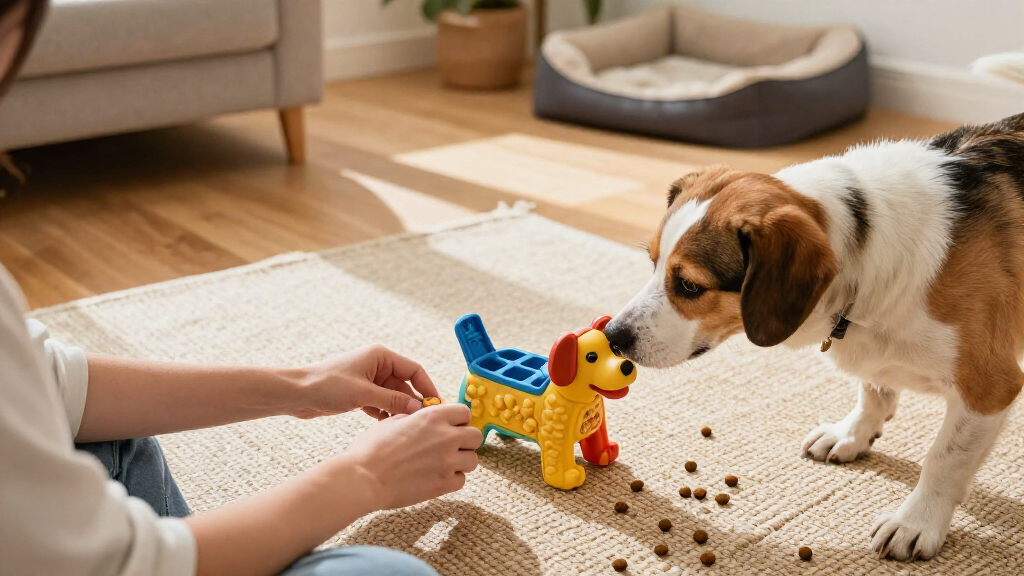
How We Picked
I ranked these interactive dog puzzle toys by how clearly their design supports a useful play experience: a dog should be able to discover how the toy works, get a reward for effort, and stay engaged without the puzzle becoming frustrating. I compared stated challenge level, interaction style, treat-dispenser or slow-feeder function, and suitability for different dog sizes and experience levels. I also weighed practical factors such as setup, cleaning, stability, and whether the toy’s moving parts could be a poor match for a persistent chewer.
The ranking favors options with a clear role and a workable balance of challenge and usability. The Dog Tornado ranks first as a broadly approachable Level 2 puzzle; the Level 4 Tower ranks lower for general use because its greater challenge is a narrower fit. Beginner-friendly and movement-based picks serve different needs, while similarly described products are separated only where their listed format or intended use supports a meaningful distinction. Product details provided do not establish durability or suitability for every dog, so I treat those as fit questions rather than guarantees.
Factors to Consider When Choosing Interactive Dog Puzzle Toys
Choosing a puzzle is less about finding the most complicated design and more about matching the task to your dog’s habits, your feeding routine, and the amount of supervision you can provide. These broader checks can help narrow the field before comparing individual models.
Match the Challenge to Your Dog’s Learning Style
A dog that has never used a puzzle may do better with a simple action and an obvious reward than with several steps to remember. Start by noticing whether your dog paws at objects, noses them, or watches for food to fall out; puzzle mechanics should invite those natural behaviors. A harder level is not automatically better, since repeated failure can lead to chewing or walking away rather than learning. You can make many treat puzzles easier at first by exposing some rewards and reducing the number of filled compartments. Increase the challenge only after your dog solves the basic task calmly and reliably. This approach helps distinguish a toy that is genuinely too easy from one that only needs a gentler introduction.
Choose Between Stationary Search and Movement-Based Play
Stationary boards ask dogs to work around compartments, sliders, or removable pieces, while wobble dispensers make movement part of the reward. The first style can support focused sniffing and problem-solving; the second may appeal to dogs that enjoy nudging objects across a floor. Think about your space before choosing, since a rolling toy can travel under furniture or make noise on hard flooring. A stationary puzzle may be easier to contain, but it can be less engaging for a dog that loses interest when food does not move. Avoid assuming that more activity means more mental work: the best format is the one your dog has to figure out rather than simply chase. Watch the first sessions to see whether the toy encourages the intended behavior.
Treat Size, Feeding Goals, and Daily Use
Check whether the openings suit the treats or kibble you plan to use; pieces that are too large may not fit, while very small pieces can fall out with little effort. If you want a puzzle to slow meals, compare its capacity and food-contact surfaces with your dog’s normal portion rather than expecting every toy to replace a bowl. Treats used for enrichment still count toward the day’s food intake, so frequent puzzle sessions may call for smaller portions. Sticky or crumbly rewards can make a toy harder to clean and may collect in narrow spaces. For a dog with food sensitivities or a prescribed diet, using familiar kibble can keep puzzle play aligned with feeding needs. The practical choice is often the toy that works with food you already use.
Account for Size, Chewing, and Supervision
A toy can be difficult to use safely if its pieces are too small for a large dog or too bulky for a small dog to manipulate. Check the manufacturer’s sizing guidance and inspect removable parts before leaving a dog alone with the puzzle. Dogs that chew when frustrated may need a sturdy, simple design and close supervision rather than a toy with pieces they can pull free. Puzzle toys are enrichment tools, not a substitute for chew toys designed for sustained gnawing. Remove a toy if it becomes cracked, loose, or damaged, and avoid letting multiple dogs compete over one food-filled puzzle. These checks matter more than a high challenge level when the dog’s play style is vigorous.
Think Through Cleaning Before Buying
Every crevice that hides treats can also hold crumbs, saliva, or residue, so look for care instructions that fit your routine. A puzzle used with dry kibble may need less frequent scrubbing than one filled with soft food, but both still need regular inspection and cleaning. Designs with many compartments can offer more hiding places while taking longer to clear completely. Do not assume a toy is dishwasher-safe unless the product instructions say so. If you know cleanup will be occasional, favor a simpler layout and dry rewards rather than a design with hard-to-reach spaces. A toy that is easy to maintain is more likely to stay in regular rotation.
Pay for the Right Kind of Variety, Not Complexity Alone
A more involved puzzle can make sense for a dog that already solves basic toys and remains interested in a longer task. For a beginner, extra steps may add frustration without adding useful enrichment. Before paying for a more elaborate design, ask whether it introduces a genuinely different action, adjusts the challenge, or serves a feeding need you have. A second toy with a new interaction style can broaden play more than another board that uses nearly identical sliders. Rotating a few toys can also preserve interest without making every session harder. Choose added complexity only when it solves a real problem in your dog’s current play routine.
Frequently Asked Questions
Which puzzle should I choose for a dog that has never used one?
Start with a toy that has an obvious reward and only a small number of steps, rather than choosing by the highest listed level. In this roundup, the Level 2 Dog Tornado is a more approachable starting point than the Level 4 Tower, though some dogs will need an even simpler introduction. Show your dog how a treat appears, leave some rewards partly exposed, and keep the first session short. If your dog starts chewing or gives up, make the task easier instead of adding more treats or increasing the challenge. The aim is to teach the interaction, not to test persistence.
Are treat puzzles a good replacement for a slow-feeder bowl?
Some puzzle toys can slow eating, but they may not hold a full meal or be as easy to clean as a bowl made for daily feeding. Check the toy’s capacity and the size of its food openings against your dog’s usual kibble and portion. A puzzle can be useful for part of a meal or occasional enrichment, while a slow-feeder bowl may be more practical for routine use. Keep an eye on your dog to make sure the food comes out without forceful chewing. If eating speed is tied to a health concern, ask your veterinarian which feeding format fits your dog.
How do I know whether my dog needs a harder puzzle?
Look for repeated, calm success: your dog solves the toy without help, stays engaged, and does not resort to chewing or throwing it. If the puzzle is finished quickly but your dog still seems interested, you can try a more involved format or make the current task slightly harder. Change one thing at a time, such as hiding treats more fully, so you can tell whether the added challenge suits your dog. A dog that walks away may be bored, confused, or simply uninterested in that interaction style. Moving to a higher level is not the only solution; a different mechanic may be a better match.
Can I leave my dog alone with an interactive puzzle toy?
Supervise the first sessions, especially if the toy has removable parts, sliding pieces, or components your dog may chew. A puzzle that appears simple can still become a chewing target when a dog cannot reach a treat. Check the toy for damage before and after use, and put it away if a piece becomes loose or cracked. Dogs that are persistent chewers or guard food around other pets need closer management. Once you know how your dog handles a specific toy, follow its care and safety instructions rather than assuming all puzzles are safe for unsupervised play.
Should I choose a stationary puzzle or a wobble dispenser?
Choose based on what your dog naturally enjoys doing and where the toy will be used. A stationary puzzle tends to suit focused sniffing, pawing, and working through compartments, while a wobble dispenser adds movement and may appeal to dogs that like to nudge objects. Consider noise and floor space too: a moving toy can travel or sound different on hard surfaces than a board placed in one spot. Neither format is automatically more enriching, and some dogs prefer one while ignoring the other. If your dog’s play style is unclear, begin with a simple session and watch how they interact before investing in a more complex format.
Conclusion
For a broad starting recommendation, I’d choose the Outward Hound Nina Ottosson Dog Tornado: its Level 2 format makes it a practical match for many dogs without aiming at advanced puzzle solvers only. For best value, compare the simpler options by the play style and feeding use you actually need; the product details here do not support a price-based value claim. The Level 4 Tower of Treats is my premium-style pick for dogs already comfortable with puzzle play and ready for a harder task, not for first-timers. For beginners, start with a manageable Level 2 design such as the Tornado or Dog Brick and make the first session easy. For small dogs and puppies, the wobble dispenser is the specific-fit choice; for dogs that need a slow-feeding routine, compare the slow-feeder designs and check capacity, food fit, and cleanup before deciding.