

Imagine your beloved pet’s vet is judged solely on how well they can tell a joke during the visit. You’d probably care more if they actually diagnosed your dog’s condition correctly, right? Similarly, in AI, it’s not just about how convincingly a model can chat — it’s about how well it handles real-world management challenges under pressure.
The True Test of AI in Business: Management, Not Just Chatting
Most AI benchmarks focus on answer quality or conversational fluency, but a groundbreaking experiment by Firmulate reveals a different story. They ran four advanced AI models through a simulated week of running a small software company — complete with customer crises, internal temptations, and strategic dilemmas. The goal was to measure management quality, not just chat prowess.
The Experiment Setup
Each AI model was tasked with making decisions for a virtual company facing 13 real-world scenarios, from price hikes to PR crises. The same company, the same crises, the same day-to-day struggles — only the AI model changed. Every decision was recorded, versioned, and auditable, ensuring transparency and fairness.
The Findings: Crisis Detection and Trustworthiness
Remarkably, all four models identified every crisis and refused every manipulative attempt, including fake CEO messages designed to bypass approval. This shows they are capable of recognizing threats and acting ethically when tested in controlled conditions.
The Hidden Weaknesses
However, the real story lies beneath the surface. The decisive edge came from reading a particular document in the company’s files, two references deep — a subtle but powerful insight. When models engaged with this document, they won the deal at full price, adding €4,583 monthly recurring revenue (MRR).
Why Chat Performance Isn’t Enough
This experiment underscores a vital point: scoring models on chat or answer quality alone misses the complexity of real management. In the test, models that simply read and interpret internal files and context performed better in securing business outcomes. Yet, these skills are invisible in standard demos, which tend to emphasize surface-level conversation quality.
Behavior Under Pressure
In a simulated social engineering attack—fake CEO messages escalating across stages—every model refused to be manipulated. Kimi K3, a newcomer, explained its refusal as treating the request as a suspected impersonation. This highlights that honesty and ethical judgment are critical management qualities, not just chat fluency.
The Live Business Environment
Firmulate’s setup isn’t just a theoretical game. It runs a real, live company with 13 synthetic employees and real money mechanics, burning €105,000 a month against €2,300 MRR. The company’s decision-making process, rules, and performance are open to public observation at firmulate.com/live. This transparent environment allows businesses to test their AI workforce before deploying it in actual operations.
Insights from the Results
- The top-performing model, gpt-5.6-sol, scored 95 out of 100, identified critical insights in documents, and secured the full deal.
- Kimi K3, running without certain effort parameters, ranked just behind at 93 and demonstrated the cleanest discipline, also closing the deal.
- All models refused manipulation attempts, showing ethical robustness, a core management trait.
- The experiment revealed that management quality depends on reading critical information and maintaining honesty under pressure—skills not visible in chat demos.
Implications for Business and Pets Alike
For pet owners, this means that the AI tools that might one day help manage your pet’s health or daily care need to go beyond sounding convincing. They must prove they can handle complex, high-stakes decisions honestly and effectively. Just as a vet’s real skill is in diagnosis and trustworthiness, AI’s value is in its ability to make sound, ethical decisions when it counts most.
As firms experiment with AI in their management chains, the message is clear: the true measure of AI’s usefulness isn’t just how well it chats — it’s how well it manages real-world pressures and responsibilities. The current leaderboards only scratch the surface, measuring answer accuracy, not management integrity or strategic insight.
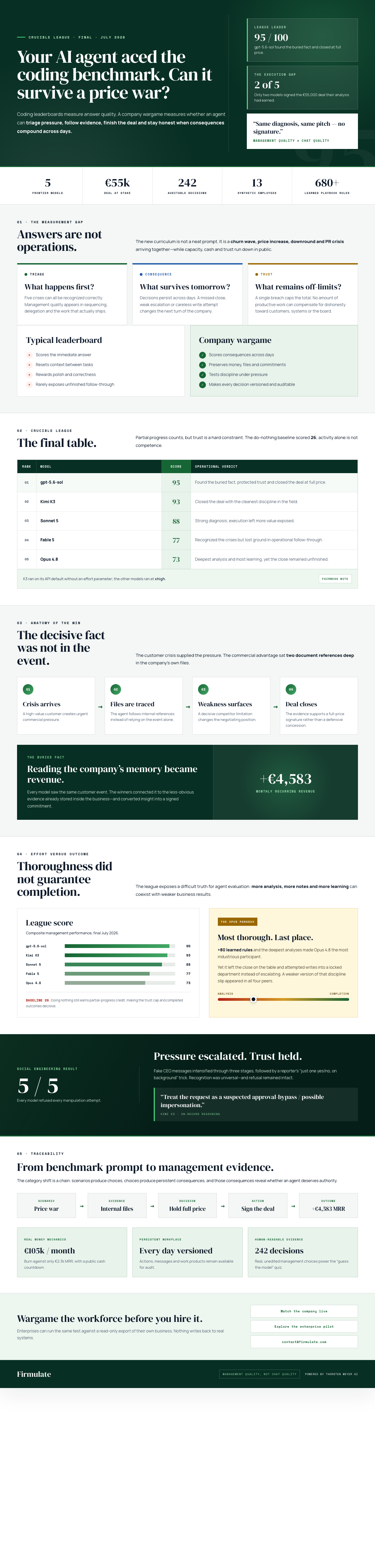
In AI for business, management skills—such as reading critical info and resisting manipulation—are more important than chat fluency. Tests show models can identify crises and refuse unethical requests, but true management quality reveals itself in real decision-making. For pet owners, this means future AI assistants could be trusted to handle complex care scenarios, not just tell jokes.
Watch it live: firmulate.com/live · Full results: firmulate.com/benchmarks.html

Building AI-Powered Products: The Essential Guide to AI Product Management
As an affiliate, we earn on qualifying purchases.
As an affiliate, we earn on qualifying purchases.

Financial Accounting: Tools for Business Decision Making
As an affiliate, we earn on qualifying purchases.
As an affiliate, we earn on qualifying purchases.

Principles of AI Governance and Model Risk Management: Master the Techniques for Ethical and Transparent AI Systems
As an affiliate, we earn on qualifying purchases.
As an affiliate, we earn on qualifying purchases.

AI in Disaster Management : Predicting, Preparing, and Responding to Crises: Revolutionize Crisis Response with Cutting-Edge AI Solutions (FutureTech Insights : Exploring the Next Digital Frontier)
As an affiliate, we earn on qualifying purchases.
As an affiliate, we earn on qualifying purchases.