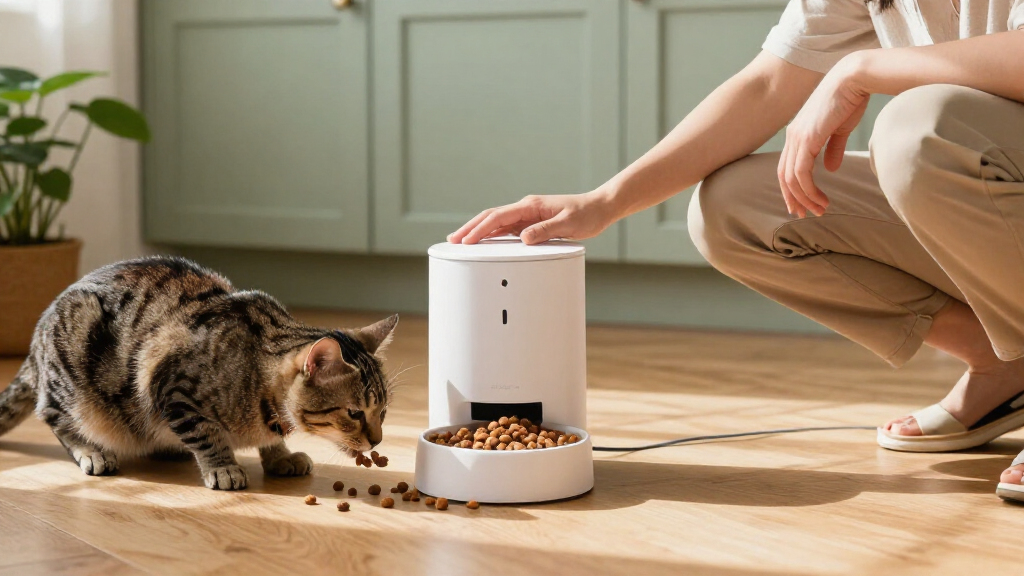
Automatic pet feeders can keep dry-food meals on schedule, but the right choice depends on whether you need simple timed portions, camera check-ins, or separate feeding for multiple pets. I’d rank the PETLIBRO WiFi Automatic Pet Feeder, 5L as the best overall choice for its balance of scheduled feeding and connected controls. For households with two cats, the oneisall feeder for two cats stands out for shared feeding, while the Frienhund 7L feeder pairs a large reservoir with a high-resolution camera. The main tradeoffs are capacity versus counter space, app features versus setup simplicity, and added monitoring versus cost and complexity. Read on for the full breakdown, buying advice, and answers to common questions.
Complete the kit


Key Takeaways
- The PETLIBRO WiFi 5L feeder is the most balanced pick: it combines app-based scheduling with a mid-size reservoir, without making a camera the main reason to buy.
- Multiple-pet households have distinct choices: oneisall’s two-cat model is aimed at shared feeding, while PETLIBRO’s dual-bowl camera model adds remote monitoring.
- Camera features come with tradeoffs: the Frienhund offers 2K video and 7L storage, while PETLIBRO’s camera options use 1080p; buyers should decide whether monitoring justifies extra setup and connectivity.
- Simple feeders still have a place: the 3L Yuposl and IMIPAW models suit buyers who want timed dry-food dispensing without prioritizing a large hopper or camera.
- Capacity and feeding format are not interchangeable: Nityers offers an 8L hopper and battery backup, while the Amazon Basics set and oneisall 2-in-1 combine gravity-fed supplies with food or water storage rather than focusing solely on scheduled portions.
| oneisall Automatic Cat Feeder for Two Cats |  | Best for Two Cats on a Shared Schedule | Capacity: 5 L / 20 cups / up to 11 lb | Schedule: Up to 6 meals per day | Portion size: About 10 g (1/12 cup) per bowl | VIEW LATEST PRICE | See Our Full Breakdown |
| Yuposl Automatic Cat Feeder, 3L with Stainless Steel Bowl |  | Best for Beginners | Capacity: 3 L / 12 cups | Scheduled meals: 1–6 per day | Kibble size: 2–15 mm | VIEW LATEST PRICE | See Our Full Breakdown |
| PETLIBRO WiFi Automatic Pet Feeder, 5L, Black |  | Best for App-Based Scheduling | Capacity: 5 L | Meals per day: Up to 10 | Portions per meal: 1–48 portions; 1/12 cup each | VIEW LATEST PRICE | See Our Full Breakdown |
| PETLIBRO Automatic Pet Feeder with 1080p Camera and Night Vision |  | Best for Remote Monitoring | Camera: 1080p HD, 145° wide-angle lens, infrared night vision | Wi-Fi: 2.4 GHz and 5 GHz | Feeding schedule: Up to 10 meals per day | VIEW LATEST PRICE | See Our Full Breakdown |
| PETLIBRO Automatic Pet Feeder with Camera, Dual Bowls, 5L, Black |  | Best Camera Feeder for Two Pets | Capacity: 5 L | Pet capacity: Up to 2 pets | Feeding schedule: Up to 6 meals daily | VIEW LATEST PRICE | See Our Full Breakdown |
| IMIPAW Automatic Cat Feeder, 3L, Programmable, White |  | Best Simple Programmable Feeder | Capacity: 3 L (12 cups) | Serving size: About 7–9 g per portion | Feeding schedule: Up to 6 meals and 20 portions per day | VIEW LATEST PRICE | See Our Full Breakdown |
| ANDOLL HOME Automatic Pet Feeder, 4 L |  | Best for a Familiar Mealtime Cue | Capacity: 4 liters | Food type: Dry food | Meal schedule: Up to 8 meals daily | VIEW LATEST PRICE | See Our Full Breakdown |
| Frienhund Automatic Pet Feeder with 2K Camera, 7L Storage, and Dual-Band Wi-Fi |  | Best for Remote Monitoring | Food capacity: 7 L (29 cups) | Camera: 3-megapixel Full HD with infrared night vision and motion detection | Wi-Fi: 2.4 GHz and 5 GHz | VIEW LATEST PRICE | See Our Full Breakdown |
| PETLIBRO RFID Automatic Cat Feeder with Wi-Fi and Diet Tracking |  | Best for Separating Cats’ Meals | Capacity: 3 liters | Access control: Included RFID collar tag; not microchip activated | Connectivity: Bluetooth and dual-band Wi-Fi (2.4 GHz and 5 GHz) | VIEW LATEST PRICE | See Our Full Breakdown |
| Amazon Basics Automatic Pet Water Dispenser and Gravity Food Feeder Set |  | Best No-Power Food-and-Water Set | Food feeder capacity: 152 fl oz | Water dispenser capacity: 135.3 fl oz | Material: Polypropylene plastic | VIEW LATEST PRICE | See Our Full Breakdown |
| PETLIBRO Automatic Cat Feeder with Portion Control and Voice Meal Call | 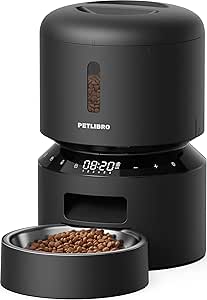 | Best for Flexible Portion Scheduling | Capacity: 3 liters | Feeding schedule: Up to 6 meals per day | Portion setting: 1–50 portions per meal; 2.5 teaspoons per portion | VIEW LATEST PRICE | See Our Full Breakdown |
| VOLUAS Automatic Cat Feeder, 4L Timed Dry Food Dispenser for Cats and Dogs |  | Best for Straightforward Setup | Capacity: 4 L / 16.9 cups | Meal schedule: 1–4 meals per day | Portion settings: 0–40 portions | VIEW LATEST PRICE | See Our Full Breakdown |
| PETLIBRO Automatic Cat Feeder with 1080p Camera and Night Vision |  | Best for Remote Monitoring | Capacity: 5 L | Camera: 1080p HD with night vision | Wi-Fi: 2.4GHz and 5GHz | VIEW LATEST PRICE | See Our Full Breakdown |
| Nityers Automatic Pet Feeder, 8L Capacity, 6 Meals per Day, LCD Screen, Battery Backup |  | Best for Large Kibble Storage | Capacity: 8 L / 34 cups | Feeding schedule: Up to 6 meals per day | Portion setting: 1–50 portions per meal; approximately 1/16 cup per portion | VIEW LATEST PRICE | See Our Full Breakdown |
| oneisall 2-in-1 Automatic Cat Feeder and Water Dispenser (8.5L) |  | Best for Combined Food and Water | Total capacity: 8.5 L | Food and water capacity: 5 L food / 3.5 L water | Feeding schedule: 1–6 meals with adjustable portions | VIEW LATEST PRICE | See Our Full Breakdown |
| automatic pet feeder | Power | Capacity |
|---|---|---|
| oneisall Automatic Cat Feeder | DC power; backup requires 4 AA batteries, not included | 5 L / 20 cups / up to 11 lb |
| Yuposl Automatic Cat Feeder | Wall power or 3 D-size alkaline batteries, not included | 3 L / 12 cups |
| PETLIBRO WiFi Automatic Pet Fe | Corded electric | 5 L |
| PETLIBRO Automatic Pet Feeder | — | — |
| PETLIBRO Automatic Pet Feeder | Corded electric | 5 L |
| IMIPAW Automatic Cat Feeder | 5V DC adapter or 3 D-cell batteries (not included) | 3 L (12 cups) |
| ANDOLL HOME Automatic Pet Feed | 5V DC adapter; backup from 3 AA batteries (not included) | 4 liters |
| Frienhund Automatic Pet Feeder | DC 5V adapter or 3 D-cell batteries | — |
| PETLIBRO RFID Automatic Cat Fe | Corded electric with battery backup | 3 liters |
| Amazon Basics Automatic Pet Wa | — | — |
| PETLIBRO Automatic Cat Feeder | USB-C with backup for 3 D-cell batteries | 3 liters |
| VOLUAS Automatic Cat Feeder | 5V USB adapter or 3 D-cell batteries, not included | 4 L / 16.9 cups |
| PETLIBRO Automatic Cat Feeder | — | 5 L |
| Nityers Automatic Pet Feeder | Type-C adapter with backup for 4 AA batteries, not included | 8 L / 34 cups |
| oneisall 2-in-1 Automatic Cat | USB-C and 4 AA batteries | — |
More Details on Our Top Picks
oneisall Automatic Cat Feeder for Two Cats
I’d put the oneisall Automatic Cat Feeder for Two Cats near the top for households that need one feeder to serve two cats at once. Its two bowls sit 16 inches apart, giving pets more room than a single-bowl setup, and it can schedule up to six meals daily with adjustable portions for each bowl. The 5 L hopper also holds more than the Yuposl 3L feeder, so it needs fewer refills for many households. A short recorded meal call adds a familiar cue, while dishwasher-safe stainless steel bowls simplify cleanup. The tradeoff is a narrower food fit: kibble must be under 0.5 inches. The main unit cannot be washed, and backup batteries are sold separately. I’d skip it if your cats need separate diets or different schedules.
Pros:- Two bowls spaced 16 inches apart serve two cats from one scheduled feeder.
- Schedules up to six meals per day with portions of about 10 g per bowl.
- 5 L hopper holds up to 11 lb of dry food.
- Dishwasher-safe stainless steel bowls and a 10-second meal-call recording.
Cons:- Accepts only kibble smaller than 0.5 inches.
- The feeder unit itself is not water-washable.
- Backup 4 AA batteries are not included.
Best for: Households with two cats that eat the same dry food and can follow a shared schedule.
Not ideal for: Owners whose cats need different diets, separately timed meals, or kibble at least 0.5 inches wide.
- Capacity:5 L / 20 cups / up to 11 lb
- Schedule:Up to 6 meals per day
- Portion size:About 10 g (1/12 cup) per bowl
- Maximum kibble size:Less than 0.5 in
- Bowl spacing:16 in
- Voice recorder:10 seconds
- Power:DC power; backup requires 4 AA batteries, not included
- Dimensions:16.73 × 7.09 × 13.4 in
- Warranty:2 years
Our verdict“Choose this feeder if two cats share a diet and you want separated bowls with a larger hopper, but skip it if their feeding needs differ.”
Yuposl Automatic Cat Feeder, 3L with Stainless Steel Bowl
The Yuposl 3L keeps setup straightforward: meal times and portions are programmed on the LCD and buttons, with no app or Wi-Fi required. That makes it a practical first automatic feeder for someone who wants a fixed routine without managing connected features. Its 2–15 mm kibble range is broader than the oneisall feeder’s sub-0.5-inch limit, and the stainless steel bowl is dishwasher-safe. The hopper is smaller than the 5 L options from PETLIBRO, so owners of larger pets may refill it more often. You can use wall power or three D batteries, though the batteries aren’t included and the stated battery life depends on use. This is a dry-food-only model; I’d pass if remote feeding or app-based records matter to you.
Pros:- LCD and buttons set one to six meals per day without Wi-Fi or a smartphone.
- Accepts dry kibble from 2–15 mm.
- Stainless steel bowl is dishwasher-safe.
- Runs on wall power or three D-size batteries.
Cons:- 3 L capacity is smaller than the 5 L oneisall and PETLIBRO feeders.
- Batteries are not included, and battery life varies with feeding demand.
- Designed for dry food only.
Best for: First-time feeder buyers who want button-based scheduling for a cat, small dog, or small animal without using a smartphone.
Not ideal for: Owners who want remote controls, feeding records, a large hopper, or a feeder for wet food.
- Capacity:3 L / 12 cups
- Scheduled meals:1–6 per day
- Kibble size:2–15 mm
- Controls:LCD screen and buttons; no Wi-Fi required
- Power:Wall power or 3 D-size alkaline batteries, not included
- Battery life:Over 180 days, manufacturer claim
- Bowl material:Stainless steel
- Cleaning:All components except the main unit are removable and washable
Our verdict“Pick the Yuposl if you want a simple, offline feeder with flexible power, but choose a larger app-connected model for remote oversight or fewer refills.”
PETLIBRO WiFi Automatic Pet Feeder, 5L, Black
For buyers who want scheduling and feeding records on a phone without adding a camera, I’d choose the PETLIBRO WiFi 5L. Its app supports up to 10 meals a day, more than the six-meal limit on the oneisall and Yuposl models, and lets you review feeding records and receive low-food or dispensing alerts. The 5 L hopper is a useful middle ground for households that want fewer refills without a dual-bowl body. A twist-lock lid, sealing strip, and desiccant help protect dry kibble, though the desiccant needs frequent replacement. Unlike the camera-equipped PETLIBRO models, this one cannot show or let you speak to your pet remotely. It also runs on corded power, and the base should not be washed. I’d favor it for routine oversight, not camera monitoring.
Pros:- App schedules up to 10 meals per day with adjustable portions.
- Feeding records and alerts help track dispensing and low-food issues.
- 5 L hopper with a twist-lock lid, sealing strip, and desiccant.
- Stainless steel bowl.
Cons:- Corded electric power only.
- Feeder base should not be washed.
- Desiccant bag needs replacement every half month.
Best for: Pet owners who want app scheduling, feeding records, and alerts in a 5 L feeder without paying for camera features.
Not ideal for: People who need battery backup, a washable feeder base, wet-food dispensing, or remote video and audio.
- Capacity:5 L
- Meals per day:Up to 10
- Portions per meal:1–48 portions; 1/12 cup each
- Kibble size:2–15 mm
- Connectivity:2.4 GHz and 5 GHz Wi-Fi; Bluetooth
- Power:Corded electric
- Dimensions:7.72 × 7.72 × 14.09 in
- Weight:4.4 lb
- Warranty:24 months
Our verdict“Choose this PETLIBRO for app-controlled schedules and alerts without a camera, but pick the camera-equipped PETLIBRO models if seeing or speaking to your pet is a priority.”
PETLIBRO Automatic Pet Feeder with 1080p Camera and Night Vision
The PETLIBRO with 1080p Camera is the pick here for owners who want to check in on a pet as well as control meals. The 145° camera, infrared night vision, and two-way audio add a level of remote monitoring the standard PETLIBRO WiFi feeder lacks; app controls also allow scheduled or on-demand meals, up to 10 times daily. Alerts for motion, sound, low food, and blockages can make it easier to spot feeding problems while away. Video can be stored on a microSD card, but the card is not included, and cloud storage requires a paid subscription. Compared with the dual-bowl PETLIBRO camera feeder, this model is better suited to a single feeding station and offers more daily meal slots. It remains a dry-food feeder, and the listed features don’t specify hopper capacity.
Pros:- 1080p camera with 145° view and infrared night vision.
- Two-way audio and activity recording support remote check-ins.
- App provides scheduled and on-demand feeding, with up to 10 meals daily.
- Alerts cover low food, blockages, motion, and sound.
Cons:- MicroSD card for local video storage is not included.
- Cloud video storage requires a paid subscription.
- Dry food only, with no hopper capacity listed in the provided specifications.
Best for: Owners who travel or work away from home and want remote video, two-way audio, and app-controlled feeding at one station.
Not ideal for: Households seeking a dual-bowl arrangement, offline controls, included video storage, or a clearly specified large hopper.
- Camera:1080p HD, 145° wide-angle lens, infrared night vision
- Wi-Fi:2.4 GHz and 5 GHz
- Feeding schedule:Up to 10 meals per day
- Portions:1–50 portions per meal
- Food type:Dry food
- Audio:Two-way audio
- Video storage:MicroSD card up to 256 GB, not included, or paid cloud subscription
- Warranty:24 months
Our verdict“Choose this model if remote camera and audio access matter more than a dual-bowl design or clearly stated storage capacity.”
PETLIBRO Automatic Pet Feeder with Camera, Dual Bowls, 5L, Black
Among the camera-equipped choices, the PETLIBRO Dual Bowls 5L is the clearest fit for two pets sharing one food supply. It combines scheduled feeding for up to two pets with a 1080p camera, night vision, two-way audio, and motion alerts. Compared with the single-station PETLIBRO camera feeder, the dual-bowl layout better matches a multi-pet household; compared with the oneisall two-cat feeder, it adds app-based monitoring but schedules only up to six meals daily. Each meal can be set from 1–50 portions, though the provided details don’t say how portions are divided between bowls, so I’d verify that setup suits your pets. Video stores locally on a microSD card, which is not included; cloud storage is optional. Hand-wash-only care and indoor use limit placement flexibility.
Pros:- Dual-bowl setup is designed to serve up to two pets.
- 1080p camera includes a 145° view and infrared night vision.
- App supports up to six daily meals and 1–50 portions per meal.
- Two-way audio, meal-call recording, and alerts for low food or malfunctions.
Cons:- Hand-wash-only care and indoor use limit cleaning and placement options.
- MicroSD card is not included; cloud storage is optional.
- Six-meal daily limit is lower than the 10-meal single-station PETLIBRO models.
Best for: Two-pet households that want app scheduling and camera monitoring from a shared 5 L feeder.
Not ideal for: Owners who need separate diets or feeding schedules, dishwasher-safe components, or an outdoor feeder.
- Capacity:5 L
- Pet capacity:Up to 2 pets
- Feeding schedule:Up to 6 meals daily
- Portions:1–50 portions per meal
- Camera:1080p HD, 145° wide-angle lens, infrared night vision
- Wi-Fi:2.4 GHz and 5 GHz
- Video storage:MicroSD card up to 256 GB; optional cloud storage
- Power:Corded electric
- Care:Hand wash only; indoor use
Our verdict“Pick this if two pets share a feeder and you want video check-ins, but choose the oneisall for a simpler two-cat setup or separate feeders for pets with different diets.”
IMIPAW Automatic Cat Feeder, 3L, Programmable, White
The IMIPAW 3L is a straightforward choice for cat owners who want scheduled portions without app setup or a camera. It supports up to six meals and 20 portions daily, while its 7–9 g portion units suit smaller servings better than a basic gravity hopper such as the Amazon Basics set, which provides no portion control. A removable tray and lid lock add practical day-to-day convenience, and the adapter-plus-battery power options can help keep meals on schedule during an outage.
The tradeoff is a dry-food-only design with a 3L capacity, so it offers less storage and remote oversight than the Frienhund feeder. Its backup D-cell batteries also need to be supplied separately, and hand-wash-only care means cleanup is not as simple as putting parts in a dishwasher. I’d choose it for dependable basic scheduling, not for monitoring meals from away or feeding a larger pet.
Pros:- Schedules up to six meals and 20 portions per day
- Adapter and optional battery power help preserve feeding during outages
- Removable tray supports easier routine cleanup
- Lid lock and angled outlet help limit food access and buildup
Cons:- Designed for dry food only
- Three D-cell backup batteries are not included
- Hand-wash-only care and 3L capacity may not suit every household
Best for: Cat owners seeking a compact, no-app feeder for scheduled dry-food portions and backup power.
Not ideal for: Owners who want camera monitoring, app-based remote control, wet-food feeding, or a larger food reserve.
- Capacity:3 L (12 cups)
- Serving size:About 7–9 g per portion
- Feeding schedule:Up to 6 meals and 20 portions per day
- Power:5V DC adapter or 3 D-cell batteries (not included)
- Material:Acrylonitrile Butadiene Styrene (ABS)
- Dimensions:7 × 12 × 7 in
- Weight:1.2 kg
- Care:Hand wash only
Our verdict“Choose the IMIPAW if you want a compact, programmable dry-food feeder with portion control, but skip it if app monitoring or larger capacity matters more.”
ANDOLL HOME Automatic Pet Feeder, 4 L
The ANDOLL HOME 4 L adds a small but useful personal touch to scheduled feeding: its 10-second voice recording plays three times at mealtime. That can help cue a pet who responds to a familiar voice, while the schedule allows up to eight meals daily. Compared with the IMIPAW, it offers more capacity and more daily meal slots; unlike the app-connected Frienhund, it keeps feeding controls simple and does not depend on Wi-Fi.
A sealed lid with a desiccant compartment and a food path designed to reduce clogging support reliable dry-food dispensing. The tilted stainless steel bowl is another practical distinction from an all-plastic bowl setup. Still, it is dry-food only, and the bowl requires hand washing. Backup AA batteries are not included, so owners need to supply them if they want outage protection. I’d pick it for a modest-capacity feeder with a voice call, not for remote monitoring or dishwasher-level cleanup.
Pros:- Schedules up to eight meals per day
- Voice recording plays at feeding time as a familiar cue
- Sealed lid and desiccant compartment help protect stored dry food
- Tilted stainless steel bowl and clog-reduction food path support practical feeding
Cons:- Three AA backup batteries are not included
- Bowl is hand-wash only
- No app or camera features for remote monitoring
Best for: Households that want a programmable dry-food feeder with a recorded voice cue and more daily meal slots than a basic timer model.
Not ideal for: Pet owners who need camera or app monitoring, dishwasher-safe parts, or a feeder for wet food.
- Capacity:4 liters
- Food type:Dry food
- Meal schedule:Up to 8 meals daily
- Voice recorder:10 seconds; recording plays 3 times at feeding time
- Power:5V DC adapter; backup from 3 AA batteries (not included)
- Bowl tilt:8 degrees
- Dimensions:12 × 7 × 13 in
- Warranty:1 year
Our verdict“Pick the ANDOLL HOME for scheduled dry-food meals with a recorded voice cue, but choose the Frienhund if remote visibility is a priority.”
Frienhund Automatic Pet Feeder with 2K Camera, 7L Storage, and Dual-Band Wi-Fi
The Frienhund 7L is the lineup’s clearest choice for owners who want to check in as well as schedule meals. Its app supports up to 15 meals per day, and the 3-megapixel camera adds infrared night vision, motion detection, and two-way audio. Against the more basic IMIPAW and ANDOLL HOME feeders, that means greater remote oversight and substantially more storage; compared with the PETLIBRO RFID model, it monitors the feeding area rather than restricting access to a particular cat.
The large tank and battery backup suit longer gaps between refills or power interruptions, while the removable BPA-free tank and dishwasher-safe stainless steel bowl make cleanup more convenient than the hand-wash-only bowls on those simpler models. The tradeoffs are extra setup and a need for separate D-cell batteries for backup. Local video storage requires a TF card, which is not included, and cloud storage is another route. I’d choose this for connected monitoring, not for a simple, low-tech feeding routine.
Pros:- App scheduling supports up to 15 meals daily
- Camera includes infrared night vision and motion detection, with two-way audio
- 7L tank holds more food than the 3L IMIPAW and PETLIBRO RFID models
- Removable tank and dishwasher-safe stainless steel bowl ease cleaning
Cons:- TF card for local video storage is not included
- Three D-cell backup batteries are not included
- App, camera, and network features add setup complexity compared with basic timed feeders
Best for: Owners of cats or small-to-large pets who want app scheduling, a camera, two-way audio, and a larger dry-food reserve.
Not ideal for: Buyers seeking a simple timer feeder, those who do not want app-connected equipment, or owners who expect local video storage without a separate card.
- Food capacity:7 L (29 cups)
- Camera:3-megapixel Full HD with infrared night vision and motion detection
- Wi-Fi:2.4 GHz and 5 GHz
- Meal scheduling:Up to 15 meals per day and 20 portions per meal
- Audio:Two-way audio
- Storage:TF card up to 128 GB and cloud storage
- Power:DC 5V adapter or 3 D-cell batteries
- Warranty:1 year
Our verdict“Choose the Frienhund if you want a high-capacity feeder with remote video and audio, but opt for a simpler model if scheduled dispensing is all you need.”
PETLIBRO RFID Automatic Cat Feeder with Wi-Fi and Diet Tracking
The PETLIBRO RFID feeder addresses a problem that ordinary scheduled feeders cannot: one cat eating another cat’s portion. Its included collar tag grants access to the designated cat, while the app adds schedules, portion settings, eating-habit tracking, and alerts. Compared with the Frienhund, which brings a camera and larger 7L tank, this 3L model puts its emphasis on individual access control rather than watching the feeding area or holding more food. That makes it a more targeted option for multi-cat homes with food stealing or separate diets.
The stainless steel bowl and lid are removable, and battery backup helps maintain feeding during a power cut. The limitation is that access depends on the supplied collar tag: it does not read a microchip. Its base and RFID reader also must not be washed with water, so cleaning calls for more care than the Frienhund’s dishwasher-safe bowl. I’d choose it for controlled access, but not for homes that need a camera or a large-capacity feeder.
Pros:- Included RFID collar tag helps reserve food for a designated cat
- App supports schedules, portion settings, eating-habit tracking, and alerts
- Battery backup can maintain feeding during power outages
- Removable stainless steel bowl and lid support routine cleaning
Cons:- Requires the included collar tag and is not microchip activated
- Feeder base and RFID reader must not be washed with water
- 3-liter capacity is smaller than the Frienhund’s 7-liter tank
Best for: Multi-cat households where one cat needs a protected portion or a separate feeding schedule.
Not ideal for: Owners who want microchip-based access, camera monitoring, a larger food tank, or feeder parts that can be rinsed freely.
- Capacity:3 liters
- Access control:Included RFID collar tag; not microchip activated
- Connectivity:Bluetooth and dual-band Wi-Fi (2.4 GHz and 5 GHz)
- Power:Corded electric with battery backup
- Bowl:Removable stainless steel bowl with lid
- Dimensions:10.43 × 9.45 × 17.13 in
- Weight:7.7 lb
- Model:PLAF301
Our verdict“Choose the PETLIBRO RFID model when keeping cats out of each other’s food matters more than camera monitoring or extra capacity.”
Amazon Basics Automatic Pet Water Dispenser and Gravity Food Feeder Set
This Amazon Basics set is the simplest option here: it pairs a gravity-fed dry-food hopper with a water dispenser, and neither needs electricity, batteries, or a programmed schedule. Transparent containers make remaining supplies easy to check, while anti-skid feet help keep the units steady on smooth floors. Compared with the portion-controlled IMIPAW or voice-enabled ANDOLL HOME, it does not time meals or measure servings; its advantage is supplying food and water with very little setup.
That simplicity has a meaningful feeding tradeoff: food is available continuously, so it is a poor fit for pets that overeat or need controlled portions. The plastic construction is lighter and less robust than stainless steel components such as the bowl on the Frienhund, and both dispensers require hand washing. I’d choose this set for pets that self-regulate and for owners who want a basic paired food-and-water station, not for diet management or scheduled meals.
Pros:- Gravity operation needs no electricity or batteries
- Includes both food and water dispensers
- Transparent hoppers make supply levels easy to check
- Anti-skid feet help limit movement on smooth floors
Cons:- Does not schedule meals or control food portions
- Hand-wash-only care requires manual cleaning
- Polypropylene construction may be less durable than stainless steel for heavy chewers
Best for: Owners of cats or dogs who self-regulate and want a no-electricity way to keep dry food and water available.
Not ideal for: Pets on measured diets, animals prone to overeating, or households that need timed meals or remote feeding controls.
- Food feeder capacity:152 fl oz
- Water dispenser capacity:135.3 fl oz
- Material:Polypropylene plastic
- Feeder dimensions:12.5 × 7 × 12 in
- Waterer dimensions:12.4 × 7 × 12 in
- Weight:1.8 lb
- Care:Hand wash only
- Included components:Water dispenser and food dispenser
Our verdict“Choose this set for uninterrupted, low-tech access to dry food and water, but avoid it if your pet needs measured or timed meals.”
PETLIBRO Automatic Cat Feeder with Portion Control and Voice Meal Call
Flexible scheduling is the appeal here: this PETLIBRO programs up to six meals a day, with portions adjustable from 1 to 50 increments. Compared with the VOLUAS VL001, which allows up to four meals daily, it offers more room to split a cat’s daily food across smaller feedings. Its sealed 3-liter hopper and desiccant bag help limit moisture exposure, while USB-C power and a three-D-cell backup provide another layer of schedule continuity during an outage.
The infrared anti-jam detection can stop dispensing when it detects an obstruction, but this is still a dry-kibble feeder, and kibble must fall within the specified 2–15 mm range. The voice message adds a familiar mealtime cue, though its short recording is no substitute for remote monitoring like the camera-equipped PETLIBRO model. Hand-wash-only care and periodic desiccant replacement add upkeep.
Pros:- Schedules up to six meals daily with 1–50 portion increments.
- Sealed 3-liter hopper and included desiccant bag help protect dry kibble from moisture.
- USB-C power with three-D-cell battery backup supports feeding during outages.
- Infrared detection stops dispensing if an obstruction is detected.
Cons:- Dispenses dry kibble only, in a specified 2–15 mm size range.
- The feeder base must not be washed, limiting cleanup options.
- The desiccant bag needs frequent replacement, about every half month.
Best for: Cat owners who want up to six scheduled dry-food meals, adjustable portions, and battery backup without paying for a camera or app features.
Not ideal for: Households feeding wet food or kibble outside the 2–15 mm range, and owners who want removable parts that can be washed more freely.
- Capacity:3 liters
- Feeding schedule:Up to 6 meals per day
- Portion setting:1–50 portions per meal; 2.5 teaspoons per portion
- Power:USB-C with backup for 3 D-cell batteries
- Kibble compatibility:Dry kibble 2–15 mm in diameter
- Voice message:Recordable message up to 10 seconds
- Safety feature:Infrared anti-jam detection
- Dimensions and weight:7.9 × 7.7 × 7.6 inches; 1.4 kg
Our verdict“Choose this PETLIBRO for more daily feeding slots and power backup than the VOLUAS, provided your cat eats compatible dry kibble.”
VOLUAS Automatic Cat Feeder, 4L Timed Dry Food Dispenser for Cats and Dogs
The LCD setup and four-meal schedule make the VOLUAS a practical pick for owners who want timed feeding without camera or app features. It holds 4 liters, more than the 3-liter PETLIBRO portion-control model, but offers fewer scheduled meals: up to four rather than six. That distinction matters if you want to divide a daily ration into several small feedings; for a simpler routine, the VOLUAS keeps the controls direct.
It runs from a USB adapter or three D-cell batteries, and power-off memory helps retain programmed settings. A recorded call can cue pets at mealtime, while removable parts make cleaning less restrictive than on feeders with a base that must stay unwashed. The tradeoff is that its portion increments are described by count, with an approximate weight rather than a guaranteed serving size, and batteries are not included. It dispenses dry food only.
Pros:- LCD screen supports direct programming without app-based setup.
- 4-liter hopper holds more food than the 3-liter PETLIBRO PLAF203.
- USB adapter and three-D-cell battery options provide flexible power.
- Power-off memory retains settings, and removable parts can be cleaned.
Cons:- Schedules no more than four meals per day, fewer than the PETLIBRO PLAF203.
- Designed for dry food only.
- Batteries are not included, and portion increments are approximate rather than a precise weight setting.
Best for: First-time feeder buyers who want a 4-liter dry-food hopper, on-device LCD programming, and a basic scheduled routine.
Not ideal for: Owners who need more than four meals daily, precise weighed portions, or a feeder that handles wet food.
- Capacity:4 L / 16.9 cups
- Meal schedule:1–4 meals per day
- Portion settings:0–40 portions
- Approximate portion size:6–7 g, about 1 tablespoon or 1/16 cup
- Power:5V USB adapter or 3 D-cell batteries, not included
- Voice recording:Up to 10 seconds
- Food type:Dry food
- Dimensions and weight:10 × 10 inches; 3.7 pounds
Our verdict“Pick the VOLUAS if you prefer simple LCD programming and a larger hopper over the six-meal flexibility of the PETLIBRO PLAF203.”
PETLIBRO Automatic Cat Feeder with 1080p Camera and Night Vision
This PETLIBRO adds live video, night vision, motion alerts, and two-way audio to the scheduled feeding basics, making it the clearest choice here for owners who want to check in remotely. Its app can schedule up to 10 meals daily and show feeding history and notifications, a broader monitoring setup than the voice-message-only PETLIBRO PLAF203. Dual-band Wi-Fi support gives it flexibility across 2.4GHz and 5GHz networks, while the 5-liter sealed tank and desiccant compartment help keep kibble stored between refills.
The extra connectivity comes with a real dependency: app-connected functions require Wi-Fi, so this is less suitable for homes with unreliable internet or buyers who want a simple standalone timer. Its camera and audio also do not change the dry-food limitation. The anti-clogging outlet and detachable parts address everyday feeding and cleaning, but the motorized base must not be immersed in water.
Pros:- 1080p camera includes night vision, live viewing, and motion alerts.
- Two-way audio and a recorded meal call allow remote interaction.
- App schedules up to 10 meals and provides feeding history and notifications.
- 5-liter sealed tank, desiccant compartment, and anti-clogging outlet support food storage and dispensing.
Cons:- App-connected monitoring and controls require Wi-Fi.
- The motorized base must not be immersed in water during cleaning.
- Camera and connectivity features add complexity beyond a straightforward feeder such as the VOLUAS VL001.
Best for: Pet owners who travel or work away from home and want scheduled dry-food feeding plus live video, alerts, and remote voice interaction.
Not ideal for: Buyers seeking a basic offline feeder, homes without dependable Wi-Fi, or anyone who needs wet-food dispensing.
- Capacity:5 L
- Camera:1080p HD with night vision
- Wi-Fi:2.4GHz and 5GHz
- Feeding schedule:Up to 10 meals per day
- Voice call recording:Up to 10 seconds
- Connectivity features:Live viewing, motion alerts, two-way audio, and feeding history
- Dimensions and weight:13.78 × 12.99 × 7.48 inches; 2.13 kg
- Warranty:24 months
Our verdict“Choose this model over the simpler PETLIBRO PLAF203 when remote camera access and app alerts matter more than a basic scheduled-feeding setup.”
Nityers Automatic Pet Feeder, 8L Capacity, 6 Meals per Day, LCD Screen, Battery Backup
The Nityers is the capacity-first choice in this group: its 8-liter hopper holds substantially more than the VOLUAS VL001’s 4 liters, so owners can refill less often. It still schedules up to six meals a day and offers 1–50 portion increments, bringing more control than the VOLUAS’s four-meal limit. A locking lid, desiccant bag, anti-jam mechanism, and stainless steel bowl round out a design focused on storing and dispensing dry kibble.
That larger hopper does not make it a fit for every diet. It handles dry kibble only, with pieces no larger than 18 mm, and the listed portion size is approximate rather than a measured weight. Type-C power has backup from four AA batteries, but those batteries are not included. Removable food-contact components simplify cleanup compared with the PETLIBRO PLAF203’s hand-wash-only base, though the Nityers lacks that model’s stated infrared detection.
Pros:- 8-liter capacity reduces how often the hopper needs refilling.
- Schedules up to six meals daily with 1–50 portion increments.
- Locking lid, desiccant bag, and anti-jam mechanism support storage and dispensing.
- Removable parts and a stainless steel bowl make cleaning more convenient.
Cons:- Not suitable for wet food or kibble over 18 mm.
- Four AA backup batteries are not included.
- Portions are listed as approximate increments, not a guaranteed weighed serving.
Best for: Multi-pet households or owners of larger cats and small dogs who want a large dry-kibble reserve and up to six scheduled meals.
Not ideal for: Pets eating wet food, kibble larger than 18 mm, or owners who need app monitoring or tightly measured portions.
- Capacity:8 L / 34 cups
- Feeding schedule:Up to 6 meals per day
- Portion setting:1–50 portions per meal; approximately 1/16 cup per portion
- Power:Type-C adapter with backup for 4 AA batteries, not included
- Food compatibility:Dry kibble up to 18 mm; not suitable for wet food
- Controls:LCD screen, manual feeding, and recordable voice message
- Bowl:6.7-inch diameter, stainless steel
- Cleaning:Removable lid, hopper, dispenser rotor, bowl, and bowl tray
Our verdict“Choose the Nityers over the smaller VOLUAS VL001 when a large kibble reserve matters more than app-based monitoring or wet-food compatibility.”
oneisall 2-in-1 Automatic Cat Feeder and Water Dispenser (8.5L)
The oneisall combines a timed dry-food feeder with a gravity-fed water dispenser, so its defining advantage is reducing the need for separate food and water stations. Its 8.5-liter total capacity is divided into 5 liters of food and 3.5 liters of water; that is a different proposition from the Nityers 8-liter food-only hopper, which dedicates its storage to kibble. The oneisall schedules one to six meals with adjustable portions and runs on USB-C or four AA batteries, while separate compartments help keep food and water apart.
Dishwasher-safe stainless steel bowls make bowl care easier than the hand-wash-only base on the PETLIBRO PLAF203. The tradeoff is its gravity water system: it has no filtration or circulation, so it does not offer the water treatment found in a powered fountain. Its long, narrow footprint may also suit a feeding station better than a cramped corner, and the backup batteries are not included.
Pros:- Combines a 5-liter food compartment and 3.5-liter gravity-fed water compartment.
- Schedules 1–6 meals with adjustable portions.
- USB-C and four-AA battery power provide two power options.
- Dishwasher-safe stainless steel bowls simplify regular bowl cleaning.
Cons:- Gravity-fed water has no filtration or circulation.
- Four AA batteries are not included.
- Its 22.6-inch length may be awkward in a compact feeding area.
Best for: Cat owners who want timed dry-food portions and a gravity-fed water supply together, with stainless steel bowls that can go in the dishwasher.
Not ideal for: Owners who want circulating or filtered water, a compact feeder, or a large food-only hopper like the Nityers 8L.
- Total capacity:8.5 L
- Food and water capacity:5 L food / 3.5 L water
- Feeding schedule:1–6 meals with adjustable portions
- Power:USB-C and 4 AA batteries
- Water system:Gravity-fed; no filtration or circulation
- Bowl material and care:Stainless steel; dishwasher-safe bowls
- Dimensions and weight:22.6 × 6.46 × 13 inches; 3 kg
- Warranty:2 years
Our verdict“Choose the oneisall if combining scheduled food and gravity-fed water in one station matters more than a filtered water system or a larger food-only hopper.”
How We Picked
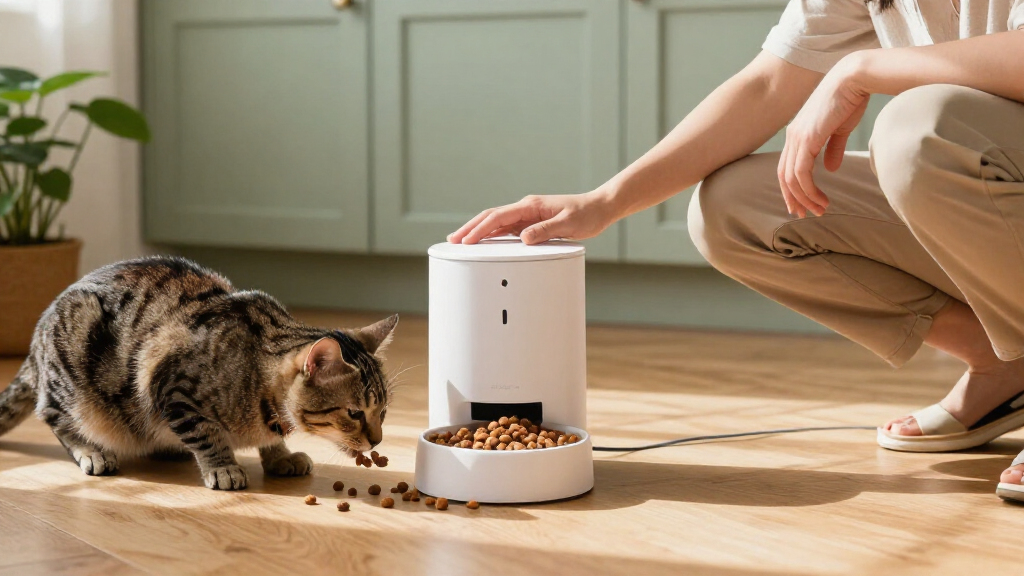
I compared the 15 listed feeders on the decisions that shape everyday use: how meals are scheduled and portioned, whether the unit supports app control or a camera, hopper capacity, feeding access for one or more pets, and the practical value of backup power or diet tracking. I also considered setup and upkeep, including whether a design adds bowls, water dispensers, or connected features that may bring extra cleaning or configuration.
The ranking favors feeders that appear to balance dependable routine feeding with useful controls and a clear fit for a common household need. More specialized models rank for their distinct strengths rather than for having the longest feature list: camera units suit remote monitoring, RFID models target food separation, and gravity-fed combinations favor convenience over precise meal scheduling. The provided product lineup does not establish measured dispensing accuracy, noise, app reliability, or compatibility with every kibble, so I avoid treating those as proven advantages; buyers should check current manufacturer guidance before purchase.
Factors to Consider When Choosing Automatic Pet Feeders
Choosing among automatic pet feeders is less about collecting features and more about matching the dispenser to your pet’s feeding routine and your home. I’d start with food type, number of pets, and what should happen if power or Wi-Fi drops, then weigh convenience against added maintenance.
Match the feeder to the food and portion routine
Many timed feeders in this roundup are intended for dry food, so check the manufacturer’s guidance on kibble size and shape before ordering. A hopper’s stated capacity does not tell you whether each dispensed serving fits your pet’s diet plan; scheduled portions and actual serving size are separate questions. If your pet needs carefully controlled meals, look for clearly stated portion increments and test the setup while you are home before relying on it. Avoid assuming that a gravity feeder offers the same meal-by-meal control as a programmable dispenser. For wet food, confirm that the unit is designed for it rather than treating any automatic feeder as suitable.
Choose capacity for your routine, not the biggest number
A larger hopper can mean fewer refills, which helps during busy weeks, but it also takes more room and can leave food stored longer. Small 3L models may be easier to place in a compact kitchen, while 7L or 8L options better suit longer refill intervals or larger feeding needs. Capacity alone does not tell you how many days of food the feeder holds: serving size and number of pets change that calculation. Estimate your household’s daily food use before comparing liters. If you travel, remember that a large hopper does not replace someone checking that the feeder and pet are doing well.
For more than one pet, plan for access as well as portions
A dual-bowl feeder can serve two pets from one unit, but separate bowls do not automatically stop one animal from eating the other’s share. Consider your pets’ size, feeding pace, and whether either needs a restricted diet. RFID-based feeding may better suit a household where one pet must have access to a specific food, though it adds setup and requires checking how the identification system works with your pets. A shared feeder is simpler when both animals eat the same food and can eat calmly near each other. If food stealing is already a problem, placement and supervised feeding may matter more than the number of bowls.
Pay for a camera only if remote checks solve a real problem
Camera-equipped feeders can help you check whether a pet approaches the bowl or see what is happening during a meal. They are not a substitute for confirming that food actually dispensed or for checking on a pet in person. Before choosing a camera model, check Wi-Fi requirements, app access, account setup, and whether video features depend on a subscription or cloud service. A model with 2K video may appeal to buyers who value sharper monitoring, while a simpler connected feeder may be enough for scheduling. If you mainly need a reliable routine, camera hardware can add complexity without changing the feeding outcome you care about.
Check backup behavior and what happens offline
Battery backup can matter during an outage, but buyers should confirm whether it is included, what batteries it uses, and which functions continue without wall power. Wi-Fi app control and scheduled feeding are different functions: some devices may retain schedules locally, while others may rely on connectivity for certain controls. Read the manual or manufacturer support details for the exact model rather than assuming every feature keeps working offline. Set a schedule and test it before leaving the feeder unattended. Keep a practical backup feeding plan, especially for pets that need medication or tightly timed meals.
Account for cleaning, refilling, and placement
A feeder that is difficult to take apart can turn a convenient routine into a maintenance chore. Check which parts are removable and whether bowls or food-contact components can be washed safely; electronics and water reservoirs may need different care. Place the unit on a stable, level surface where pets cannot tip it or reach the stored food. Water-and-food combinations save space, but they also bring two supplies to refill and clean in one area. Before committing, measure the intended spot and leave room to open the lid, remove the bowl, and refill the hopper.
Frequently Asked Questions
Can I rely on an automatic feeder while I’m away for several days?
A feeder can maintain a meal schedule, but it cannot replace a person checking on your pet. Food may jam, a device may lose power, or a pet may refuse a meal, and a camera cannot resolve every problem. Before a trip, run the feeder through its schedule and confirm how it behaves without Wi-Fi and during a power interruption. Arrange for someone to check food, water, and your pet in person. The longer you are away, the less sensible it is to rely on the feeder alone.
Is a camera feeder worth choosing over a regular Wi-Fi feeder?
A camera is useful when seeing your pet’s behavior during a meal answers a question that app notifications cannot. It may help you check whether a pet comes to the bowl, but it does not prove the correct portion was dispensed or that the pet ate it. Camera models also add network setup, app permissions, and possible service requirements, so verify those details before buying. If scheduled feeding is your only need, a non-camera connected option may be simpler. Choose video for monitoring value, not just because it adds a headline feature.
Will one feeder work for two cats?
It can if both cats eat the same food, tolerate eating near each other, and do not compete for portions. A dual-bowl design offers two serving locations, but it may not control which cat eats from which bowl. If one cat needs a separate diet or tends to take the other’s meal, an RFID feeder or separate feeding stations may be a better fit. Watch both cats during initial use and adjust placement if one blocks access. The feeder’s layout matters less than the pets’ behavior around food.
Should I choose a gravity feeder or a timed automatic feeder?
A gravity feeder replenishes the bowl as food is eaten, while a timed feeder releases portions on a schedule. Gravity models can be convenient for households that want fewer controls, but they may not help manage meal timing or intake as precisely. Scheduled models make more sense when routine and portioning are the priority, though they require programming and regular checks. The Amazon Basics set and oneisall 2-in-1 combine gravity-style supply with water dispensing, so compare them with timed options based on the routine you need. Ask your veterinarian before changing a pet’s feeding pattern for weight or health reasons.
What should I check before buying a feeder for a pet on a special diet?
Start by confirming the feeder supports your pet’s food type and the portion size prescribed for each meal. Then consider whether other pets can reach the food; a shared bowl or open gravity feeder may undermine separate diets. RFID access control may help in some homes, but verify compatibility and how the system identifies each pet. Keep the feeding schedule and serving amounts consistent with veterinary instructions, and monitor the first meals rather than assuming a programmed setting is correct. For medication-related or medically restricted feeding, ask your veterinarian whether a feeder is appropriate.
Conclusion
For most households, I’d choose the PETLIBRO WiFi Automatic Pet Feeder, 5L as the best overall balance of connected scheduling and practical capacity. The Yuposl 3L or IMIPAW 3L is a sensible value-oriented direction for buyers who want straightforward timed dry-food feeding without paying attention to camera features. For beginners, I’d favor a simple programmable model such as VOLUAS and confirm its controls and food compatibility before setting a routine. Buyers seeking premium monitoring can compare the Frienhund 2K camera feeder with PETLIBRO’s 1080p camera options; those feeding two pets should look closely at oneisall’s two-cat feeder or PETLIBRO’s dual-bowl camera model. For individual needs, the PETLIBRO RFID feeder targets diet separation, Nityers offers a large 8L hopper with battery backup, and the Amazon Basics or oneisall 2-in-1 suits buyers seeking a gravity-fed food-and-water setup rather than precise timed portions.