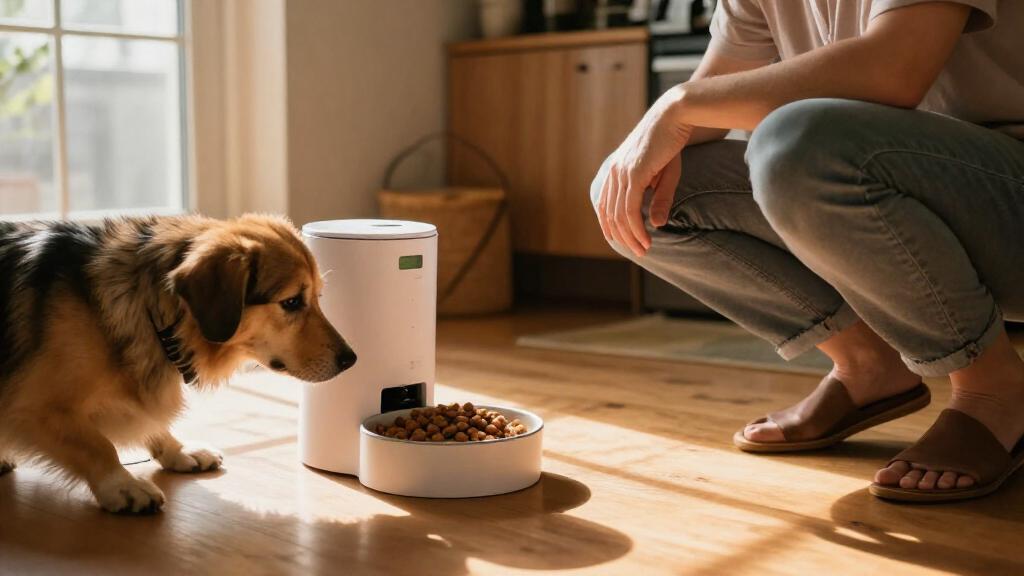
When comparing automatic dog feeders with timers, the practical choice is usually between a basic programmable model and a smart feeder controlled through an app. Both can dispense food on a schedule, but they differ in how much control you have away from home, how easy they are to manage, and how many technical dependencies they introduce. A basic feeder is usually the better fit when you want a routine meal schedule with minimal setup. A smart model can make sense if you often change feeding times remotely or want alerts, provided its app and network features are worth the higher cost to you.

Automatic Pet Feeder, 8L Capacity, Programmable 6-Meal Dispenser
- ✔ Capacity: 8L, approximately 34 cups
- ✔ Schedule: Up to 6 meals per day
- ✔ Portions: 1–50 portions per meal; approximately 1/16 cup per portion

ANDOLL HOME Automatic Pet Feeder, 4 L
- ✔ Capacity: 4 liters
- ✔ Schedule: Up to 8 meals per day
- ✔ Voice recording: 10 seconds; plays 3 times at feeding time
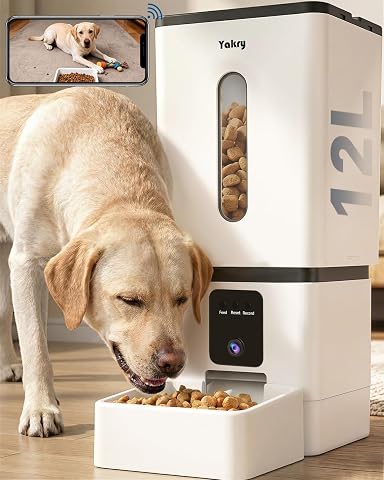
Yakry Automatic Dog Feeder with Camera, 12L Capacity
- ✔ Capacity: 12 liters / up to 50 cups
- ✔ Schedule: 1–15 meals per day
- ✔ Portions: 1–20 portions per meal
Neither type replaces checking that your dog is eating, and no timed feeder should be treated as a cure for a medical or behavioral problem. The deciding tradeoff is straightforward: pay extra for remote oversight and flexibility, or keep the system simpler and rely on controls at the feeder.
At a Glance
| Criteria | Basic programmable automatic dog feeder | Smart app-connected automatic dog feeder | Winner |
|---|---|---|---|
| Scheduling and everyday control | Set meal times and portions on the feeder; changes generally require access to its controls. | Set schedules on the feeder and, on supported models, adjust them through an app. | B |
| Remote access and alerts | No app access; check the feeder and food supply in person. | May offer remote changes, meal logs, and low-food or dispensing alerts; features vary. | B |
| Setup and reliability | Fewer connected features and less network setup; still requires correct setup and maintenance. | Adds account, app, and sometimes Wi-Fi dependencies; connectivity problems can limit remote functions. | A |
| Portion control | Depends on the model and food shape; verify the stated portion size and test dispensing. | Still model-dependent; an app does not by itself make portions more accurate. | Depends |
| Food capacity and compatibility | Varies by model; many are designed for dry kibble, with capacity listed by volume or weight. | Varies by model; check kibble compatibility and capacity just as carefully as with a basic unit. | Tie |
| Power backup | Some models use batteries or offer backup power; check whether backup is included. | Backup options vary; confirm whether scheduled feeding continues during power or internet loss. | Depends |
| Value | Usually lower upfront cost for scheduled feeding without remote features. | Higher cost can pay off for owners who use remote control and alerts regularly. | Depends |
Automatic Pet Feeder, 8L Capacity, Programmable 6-Meal Dispenser
This is our most balanced choice for owners who want a dependable timed routine without adding an app or camera to the setup. Its 8L hopper holds about 34 cups, and the schedule supports as many as six meals per day. Compared with ANDOLL’s 4-liter model, that larger reserve can mean fewer refills, although ANDOLL offers two more daily meal slots. The Yakry holds more still, but the 8L unit avoids the extra connectivity layer.Portions can be set from 1 to 50 increments per meal, with each increment approximately 1/16 cup. That is useful for tailoring a schedule, but the listed increments should not be mistaken for a veterinary feeding plan; owners should confirm the amount their dog needs. A manual feed option also lets us dispense food outside the programmed timetable. The LCD screen and recordable voice message round out the routine-focused controls.For food handling and upkeep, this model pairs a locking lid and desiccant bag with a stainless steel bowl. Its hopper, rotor, lid, bowl, and tray are removable, which gives it a cleaning advantage over ANDOLL’s hand-wash-and-wipe guidance. The tradeoff is food compatibility: it is limited to dry kibble no larger than 18 mm, a narrower stated size ceiling than Yakry’s 20 mm. It can use a Type-C adapter or four AA batteries, but the batteries are not included. For owners who want an app camera, the Yakry is the better fit; for a flexible offline timer, this is the stronger all-rounder.
Pros:
- 8L capacity holds approximately 34 cups and reduces refill frequency compared with ANDOLL.
- Schedules up to six meals daily with adjustable portions and manual dispensing.
- Type-C power plus optional four-AA backup and a locking lid.
- Removable food-contact components and a stainless steel bowl support easier cleaning.
Cons:
- Dry kibble only, with a maximum stated size of 18 mm.
- Four AA backup batteries are not included.
Best for: Owners who want a high-capacity dry-food feeder with adjustable scheduled meals, manual dispensing, and removable parts for routine cleaning.
Not ideal for: Households that need wet-food dispensing, use kibble larger than 18 mm, or want app-based remote feeding and camera monitoring.
Bottom line: We recommend this as the most balanced timer feeder for dry-food routines that need generous capacity and manageable cleaning without app dependence.
“We recommend this as the most balanced timer feeder for dry-food routines that need generous capacity and manageable cleaning without app dependence.”
ANDOLL HOME Automatic Pet Feeder, 4 L
ANDOLL is the compact, straightforward pick for owners whose priority is dividing the day into more scheduled feedings. It supports up to eight meals per day, more than the 8L model’s six, though its 4-liter hopper holds less than half as much food as that option. That makes it better suited to smaller dogs, shorter periods between refills, or homes where storage space matters more than a large reserve.A 10-second voice recording plays three times at feeding time, adding a familiar cue to the timer. The sealed lid and desiccant compartment are intended to help keep dry food fresh, while the tilted stainless steel bowl angles toward the dog. Its 5V DC adapter has backup support from three AA batteries, which are not included. Compared with Yakry, ANDOLL has no listed app or camera; that keeps the core task focused on programmed dispensing rather than remote monitoring.Its compromises show up in capacity and care. The supplied specifications say to hand wash and wipe clean, rather than describing the multiple removable dispensing components listed for the 8L feeder. We also do not have a stated kibble-size limit or portion increment specification here, so buyers with unusually large kibble or precise portion requirements should verify those details before relying on it. This is a sensible option when eight timer slots matter, but households seeking fewer refills or more detailed portion control have a clearer case for the 8L model.
Pros:
- Schedules up to eight meals per day, more than the 8L model.
- 10-second voice recording plays three times at feeding time.
- Sealed lid, desiccant compartment, and tilted stainless steel bowl.
- Adapter power with optional three-AA battery backup.
Cons:
- 4-liter capacity requires more frequent refills than the 8L and 12L options.
- Backup batteries are not included, and cleaning guidance is hand wash and wipe clean.
Best for: Owners who want up to eight timed meals per day in a smaller feeder and do not need app control or a camera.
Not ideal for: Households that want a large food reserve, removable cleaning components, or documented portion increments and kibble-size limits.
Bottom line: We’d choose ANDOLL when frequent scheduled feedings and a compact footprint outweigh hopper capacity and extensive cleaning access.
“We’d choose ANDOLL when frequent scheduled feedings and a compact footprint outweigh hopper capacity and extensive cleaning access.”
Yakry Automatic Dog Feeder with Camera, 12L Capacity
Yakry is the most capable option here for owners who want to manage feeding when they are away from the feeder. Its app supports scheduled and remote dispensing, and the 1080p camera with night vision and two-way audio lets us check in and communicate. Compared with the other two models, this adds a monitoring layer as well as a timer. It makes the most sense when that remote access is useful often; if we only need meals to drop on a fixed schedule, the 8L feeder is simpler.The schedule allows 1–15 meals per day, the widest range in this group, and portions can be adjusted from one to 20 increments per meal. A 12-liter hopper holds up to 50 cups, so it also has the largest stated capacity, and it accommodates dry kibble up to 20 mm. Those figures make Yakry more flexible than the 8L model for larger kibble and longer stretches between refills. Its USB power source has optional backup from three D batteries, sold separately.The extra features bring practical dependencies. App control uses Wi-Fi, so remote dispensing and live check-ins depend on the home network and setup; the supplied details list both 2.4 GHz and 5 GHz Wi-Fi. The unit is designed for dry food only, and its camera and communications may be unnecessary complexity for buyers seeking a basic timer. An airtight lid, desiccant bag, and removable bowl support storage and cleaning, but the details provided do not list the same set of removable hopper and rotor parts as the 8L feeder. Choose Yakry when remote oversight and its broad schedule are central to the routine, not simply because it has the most features.
Pros:
- 12-liter hopper holds up to 50 cups, the largest stated capacity in this lineup.
- Schedules 1–15 meals daily and supports dry kibble up to 20 mm.
- App feeding, 1080p camera with night vision, and two-way audio enable remote check-ins.
- Airtight lid, desiccant bag, removable bowl, and two-year warranty.
Cons:
- Remote functions depend on Wi-Fi and app setup.
- Dry food only; three D backup batteries are not included.
Best for: Owners who want a large-capacity feeder with a broad meal schedule, remote app dispensing, and camera check-ins while away.
Not ideal for: Buyers who want a simple offline timer, do not need a camera, or prefer not to depend on Wi-Fi for remote features.
Bottom line: Yakry is our premium pick when remote dispensing and camera monitoring add real value to a flexible, high-capacity timer routine.
“Yakry is our premium pick when remote dispensing and camera monitoring add real value to a flexible, high-capacity timer routine.”
As an Amazon Associate we earn from qualifying purchases.
Key Differences
The clearest advantage of a smart feeder is control from a distance. If your plans change, an app may let you alter a meal time without returning home, and alerts can help you notice a low food supply or a missed dispensing event. Those features matter most when you are away during feeding times and will respond to the notifications. If you usually keep a stable routine, app control may add little to the daily experience.
A basic feeder has fewer connected parts to configure and depend on. That can make it a more straightforward choice for someone who wants scheduled portions without managing an account or network connection. But basic does not mean foolproof: either type can jam, lose power, or dispense an unsuitable portion if the food or settings are wrong. Smart functions also do not guarantee accurate feeding or confirm that a dog actually ate.
Price is best judged by use, not feature count. Paying more is reasonable when remote schedule changes or alerts solve a regular problem. If you only need meals dispensed at set times, spend time checking portion settings, food compatibility, capacity, and backup power before paying for connectivity.
Detailed Comparison
Scheduling and everyday control (Smart app-connected automatic dog feeder wins — moderate)
Both types can schedule meals, but a smart feeder may also let you change times and settings in its app. That is a moderate advantage for owners whose routines change. With a basic feeder, adjustments typically mean using controls on the unit, which is perfectly workable when the schedule stays consistent.
Remote access and alerts (Smart app-connected automatic dog feeder wins — major)
The smart model wins by design if its app supports remote control, feeding history, or useful notifications. The gap is major for someone who is often away when meals dispense and wants to check status. It is minor for an owner who is nearby, rarely changes plans, or will not act on alerts. Confirm the exact app features before buying.
Setup and reliability (Basic programmable automatic dog feeder wins — moderate)
A basic feeder generally avoids app accounts and network setup, so it has fewer connected dependencies. That is a moderate practical advantage for buyers who prefer simple controls. Smart features add convenience but can be unavailable when connectivity or the app has problems. Both designs still rely on working mechanics, appropriate food, and regular checks.
Portion control (major difference)
There is no category-wide winner. Portion increments and accuracy depend on the specific mechanism, settings, and kibble, not whether the feeder has an app. Compare the portion range with your dog’s feeding plan, then verify what the unit actually dispenses before relying on it. For a dog with a prescribed diet, ask the veterinarian whether the device is suitable.
Food capacity and compatibility (moderate difference)
Neither category inherently holds more food or handles more kinds of food. Capacity and kibble limits vary by model, so compare listed volume, food shape restrictions, and cleaning instructions. A large hopper can reduce refills, but it does not make a feeder suitable for wet food or every kibble size.
Power backup (major difference)
Backup power is model-specific, so neither type automatically wins. Check whether batteries are included, whether the schedule continues during an outage, and what happens if Wi-Fi drops. A smart feeder may lose remote functions without internet even if it keeps dispensing locally; the manual should clarify its behavior.
Value (moderate difference)
The basic feeder is usually better value when scheduled feeding is the only requirement. The smart model earns its higher price for owners who routinely need remote changes or will use alerts to manage meals. If those features would be occasional novelties, the extra cost is hard to justify.
Basic programmable automatic dog feeder: Pros and Cons
Pros:
- Usually costs less than an app-connected model.
- Avoids app and network setup for routine scheduling.
- Suits stable meal schedules and straightforward use.
Cons:
- Typically requires access to the unit to change settings.
- Does not provide remote meal logs or app alerts.
- Capacity, portion consistency, and backup power still vary by model.
Smart app-connected automatic dog feeder: Pros and Cons
Pros:
- Can allow remote schedule changes on supported models.
- May provide feeding history and alerts for selected events.
- Useful when the owner is often away during scheduled meals.
Cons:
- Usually costs more.
- Remote features depend on the app and connectivity.
- Smart controls do not guarantee accurate portions or confirm that the dog ate.
Who Should Choose What
Choose Basic programmable automatic dog feeder if:
- Your dog’s meal schedule is predictable and you mainly want food dispensed at set times.
- You prefer simple controls and do not need to manage feeding remotely.
- You want to keep the upfront cost down while still checking capacity, portions, and backup options.
Choose Smart app-connected automatic dog feeder if:
- You are often away during meal times and expect to change schedules from your phone.
- Feeding history or low-food and dispensing alerts would help you manage a regular household need.
- The specific app features justify the added cost and you have a dependable connection where the feeder will operate.
Skip both if: Your dog needs close supervision while eating, has feeding needs that require precise hands-on portioning, or the feeder cannot safely dispense the food you use. Ask your veterinarian about a suitable feeding plan for medical needs.
Value for Money
The basic programmable feeder is the stronger value for a stable routine: it handles timed dispensing without charging extra for remote features you may not use. Paying more for a smart model is worthwhile when you often need to adjust meals away from home or will regularly use its alerts and history. Before spending more, check which features the exact model includes, whether its schedule runs without internet, and whether it provides backup power. App access does not replace checking the food supply or confirming your dog is eating.
Final Verdict
For most owners who simply want meals dispensed on a dependable schedule, choose a basic programmable feeder and prioritize suitable portions, compatible kibble, easy cleaning, and a clear backup plan. Choose an app-connected feeder if remote changes or alerts solve a recurring problem and the model keeps scheduled dispensing dependable when the network is unavailable. The biggest deciding factor is whether you will use remote control often enough to justify the higher price. If your dog’s feeding requires close observation or precise hands-on control, skip both and follow a plan suited to that need.
Frequently Asked Questions
Are smart automatic dog feeders more accurate with portions?
Not automatically. Portion accuracy depends on the dispensing mechanism, settings, and kibble. Compare the model’s portion increments with your dog’s feeding plan and check the dispensed amount before relying on it.
Will a timed feeder work if the Wi-Fi goes out?
That depends on the model. Some keep a locally stored schedule while remote access and alerts stop; others may behave differently. Check the manual for what happens during internet or power loss, and whether battery backup is available.
Can I use an automatic feeder for wet food?
Many timed feeders are designed for dry kibble, and food compatibility is model-specific. Use wet food only if the manufacturer explicitly supports it and describes safe storage for the time it will sit in the feeder.
Is an automatic feeder a good choice for every dog?
No. Dogs that need supervision, precise hands-on portions, or help preventing food stealing may not be a good fit. Discuss the device with your veterinarian if your dog’s diet or health requires close management.